AI visibility tools track whether, where, and how your brand appears in answers from ChatGPT, Google AI Overviews and AI Mode, Gemini, Perplexity, Claude, and Copilot.
The best AI visibility tool for you depends on your SEO stack, the engines your buyers use, and who will act on the data.
The article covers 10 tools: Peec AI, Profound, Otterly AI, Semrush AI Visibility Toolkit, Ahrefs Brand Radar, Scrunch, AthenaHQ, SE Visible, Writesonic, and ziptie.ai.
For each tool, you’ll find what it tracks, how it collects answers, what it costs as of November 2026, and who it suits best.
The article also covers how to check your AI visibility for free before paying for anything, and what a visibility score can and can’t tell you.
AI visibility tools compared
Filter by price, trial or refresh rate, sort the list, and open any tool for its engines, collection method and prompt source.
-
- Engines in base plan
- Choose 3 of 6: ChatGPT, AI Mode, AI Overviews, Microsoft Copilot, Gemini, Naver AI
- Collection method
- Scrapes the interface and captures what a logged-out user sees
- Prompt source
- Your prompts, plus suggestions and prompts built from keywords
-
- Engines in base plan
- Trial: ChatGPT, Gemini, Google AI Overviews; Enterprise up to 9
- Collection method
- –
- Prompt source
- Industry prompt set on trial; editable on Enterprise
-
- Engines in base plan
- ChatGPT, Google AI Overviews, Perplexity, MS Copilot; Claude, AI Mode and Gemini as paid add-ons
- Collection method
- –
- Prompt source
- Your prompt library, plus a prompt research tool
-
- Engines in base plan
- ChatGPT, Gemini, Google AI Overviews, AI Mode (Brand Performance adds Perplexity)
- Collection method
- Responses captured from real requests, not LLM APIs
- Prompt source
- Semrush prompt database for research reports; your prompts for tracking
-
- Engines in base plan
- Index: AI Overviews, AI Mode, ChatGPT, Perplexity, Gemini, Copilot; Custom Prompts add Claude
- Collection method
- Web version of each chatbot, default model, no personalization
- Prompt source
- Ahrefs' index of 525 million+ prompts built from search demand; Custom Prompts set by you
-
- Engines in base plan
- ChatGPT, Perplexity, Google AIO, Copilot; 9 engines on Enterprise
- Collection method
- –
- Prompt source
- Auto-generated or imported
-
- Engines in base plan
- Free plan: ChatGPT, Perplexity, AI Overviews, Gemini, Copilot; Starter: 11 models
- Collection method
- –
- Prompt source
- Yours, plus discovery from your site, Search Console, social, and keyword gaps
-
- Engines in base plan
- ChatGPT, AI Overviews, AI Mode, Gemini
- Collection method
- Real AI responses via a browser and graphical interface
- Prompt source
- Your prompts, plus localized suggestions
-
- Engines in base plan
- ChatGPT, Gemini, Google AI Overviews; 9 platforms on Enterprise
- Collection method
- Crawls the AI interface the way a user does, not through APIs
- Prompt source
- Your prompts; data sources include Keyword Planner, Google SERPs, and Reddit
-
- Engines in base plan
- Up to 7 at one price, depending on country: ChatGPT, Google AI Overviews, Perplexity, Google AI Mode, Microsoft Copilot, Bing AI Overview, Google Gemini
- Collection method
- Third-party AI-answer data providers submit your prompts and return the public answer
- Prompt source
- Your prompts, a starting set from the Project Wizard, and auto-suggested prompts with the UGC Impact Analysis add-on
Engines, collection methods, prompt sources, refresh rates and entry prices are taken from the vendors’ own pages on 1 November 2026. Price sorting uses the number in the entry price column. Profound sells by quote, so it sits last when sorted by price.
Source: Vendor websites, 1 November 2026
Five rows need a closer read before you compare entry prices. AthenaHQ’s credits run out faster on five engines. Otterly’s and Peec’s totals rise with add-on engines, and Semrush charges per user. Writesonic’s price assumes annual billing, while the others are monthly.
How these ten tools were chosen
The shortlist started with more than 40 AI visibility tools on the market. A tool made the final ten if it met all four entry criteria:
- Purpose: it’s sold as an AI visibility tracker that reports brand mentions or citations in AI engine answers. I excluded general SEO suites, content optimization tools and the free Google and Bing reports (covered in the FAQ).
- Engine coverage: its supported engines include ChatGPT and at least one Google AI surface, either AI Overviews or AI Mode.
- Public documentation: its homepage and product pages state what it tracks and which engines it covers.
- Current availability: it’s on sale as of November 2026 with a live pricing or plan page.
I then compared every tool on this list on six points:
- Engines tracked: which AI engines are in the base plan and which cost extra.
- Collection method: whether answers come from the chat interface, an API or data providers. An API answer can differ from what a user sees in the app, and a logged-out capture misses personalization, so two tools can report different scores for the same prompt.
- Prompt source: whether prompts are yours, suggested, or drawn from a vendor index.
- Refresh cadence: how often each prompt is re-run.
- Price: the entry price in USD, with add-ons and limits noted.
- Free access: a free plan, trial, or free checker.
Every fact comes from the tool’s own homepage, product page, and pricing page, read on 1 November 2026, with its documentation used where the pricing page left gaps.
What AI visibility tools do
An AI visibility tool, also called an AI search monitoring tool, sends a fixed set of prompts to AI engines on a schedule and records the answers. It reports whether your brand was mentioned or cited, in what position and tone, and against which competitors.
Otterly, for example, sends queries to AI search engines such as ChatGPT, Perplexity, Google AI Overviews and AI Mode, then analyzes the responses for brand mentions, citations and source links.
These tools report two signals from each answer:
- Mentions: the answer names your brand.
- Citations: the answer links to one of your pages as a source.
Some tools also report crawler activity, meaning which AI bots fetch your pages. Peec, Profound, Scrunch and Writesonic include it, and Otterly adds it from Standard.
Prompt-only tools can’t see it. ziptie.ai observes only what the engines publicly say, so it misses both crawler hits and referral sessions.
AI visibility tools use two data models. In prompt tracking, you choose prompts and the tool runs them on a schedule. In a prompt index, the vendor runs a large prompt set itself and lets you look up any brand. Several tools here offer both.
Ahrefs’ index holds more than 525 million prompts, Semrush’s prompt database more than 317 million, and Writesonic’s Enterprise-only Brand Explorer also researches any brand. Profound’s Prompt Volumes answers a different question: how often topics come up in AI conversations.
AI visibility tracking does a different job from the rank tracking in traditional SEO tools. A rank tracker records where your URL sits in a list of links.
An AI visibility tool reads a written answer that may name you, cite you, or do neither. A brand can rank first in Google’s traditional search results and still go unmentioned in ChatGPT.
The 10 best AI visibility tools for your team
These ten tools split into three groups: dedicated trackers (Peec AI, Profound, Otterly AI, Scrunch, AthenaHQ, ziptie.ai), SEO-suite products (Semrush, Ahrefs, SE Visible), and a content platform with tracking built in (Writesonic).
1. Peec AI: Best for marketing teams that want to choose their engines, with no seat limits
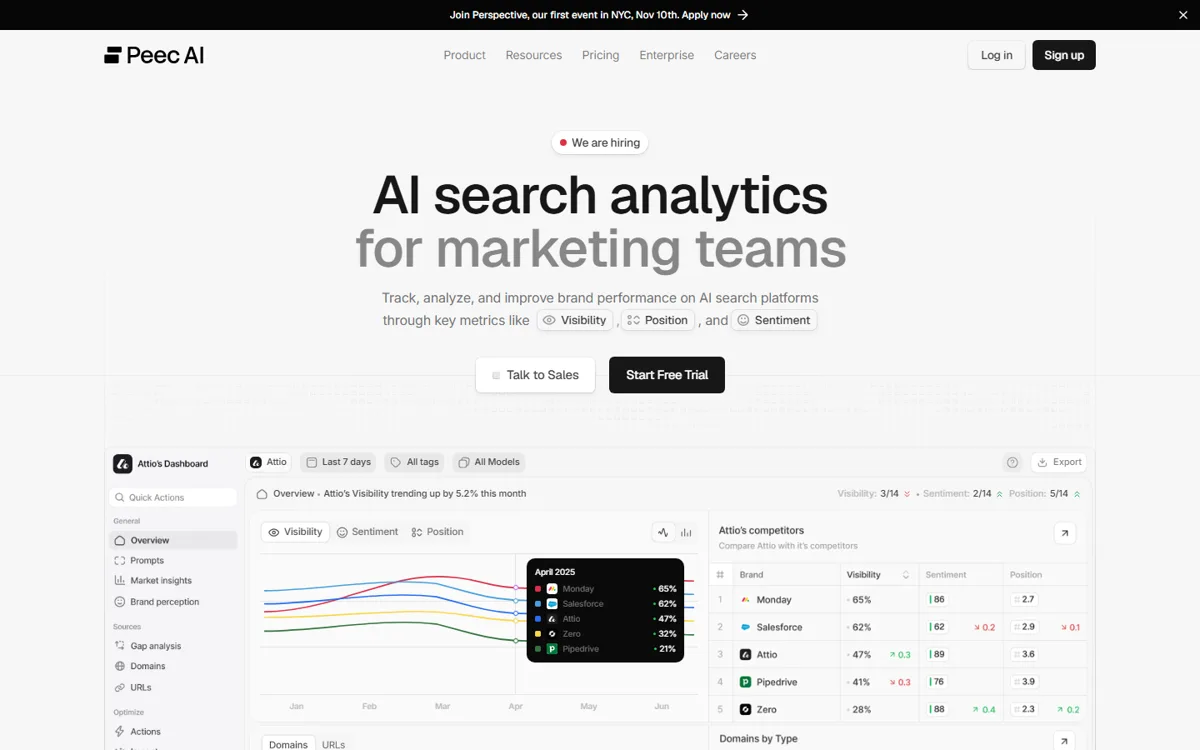
Peec AI runs your prompts once a day on three AI engines you choose. It reports visibility, position, sentiment and share of voice against the competitors in the same answers.
How Peec AI works:
- Runs each prompt once every 24 hours on every AI model you’ve selected, which gives comparable trend data across dates, models, and regions.
- Suggests prompts, builds them from keywords, scores each prompt’s demand from 1 to 5, and reports the sources behind every answer.
- Audits which AI bots your robots.txt allows and ranks recommended actions. CSV export, Google Analytics, and Model Context Protocol (MCP) access are on every plan.
Engines and collection
On self-serve plans, you pick three models at a time from ChatGPT, AI Mode, AI Overviews, Microsoft Copilot, Gemini and Naver AI. Peec AI scrapes each interface and records what a logged-out user sees.
Enterprise tracks up to 13 models, including Claude, Grok, DeepSeek, and Perplexity.
Peec AI pricing as of November 2026
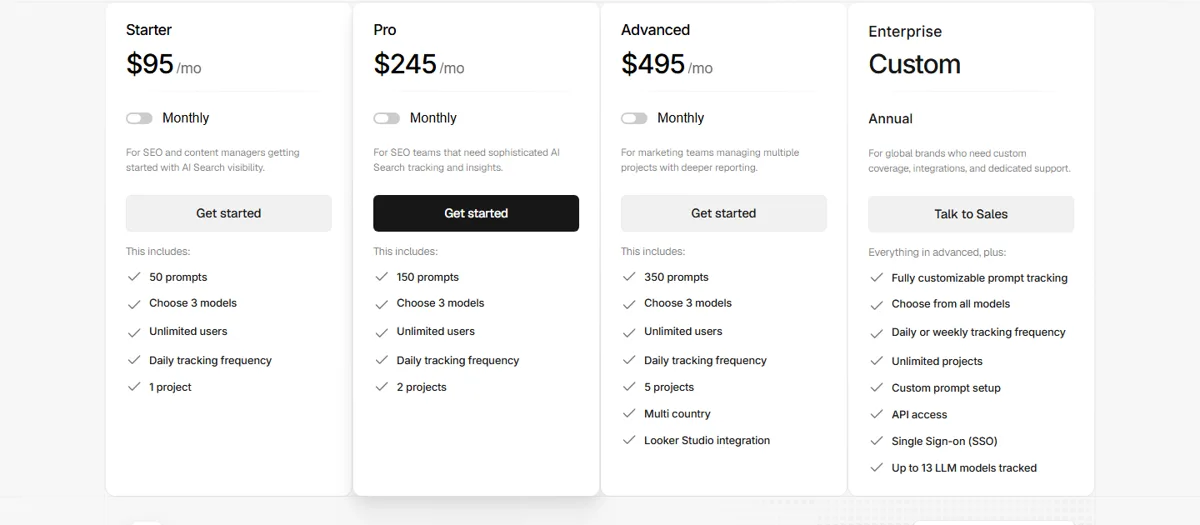
- Starter: $95/mo for 50 prompts and one project
- Pro: $245/mo for 150 prompts and two projects
- Advanced: $495/mo for 350 prompts and five projects
- Enterprise: custom
Users are unlimited, and annual billing takes 15% off. Extra models cost more on larger plans, because the price scales with your prompt count. Prices are shown in USD, though Peec’s site may display them in euros depending on where you are.
Peec AI strengths
- Every self-serve plan runs prompts daily, so trend lines stay comparable across models and dates.
- Users are unlimited, so adding teammates or clients never raises the plan price.
- SOC 2 is included on every plan, including Starter, which helps with security reviews.
Peec AI limitations
- Self-serve plans track only three models at a time, and each extra model is an add-on that costs more on larger plans.
- API access starts on Pro, so Starter has no API.
- Looker Studio connects only from Advanced.
- Starter covers one country, so tracking more markets needs a higher plan.
2. Profound: Best for enterprise brands and for agencies that sell AI search services
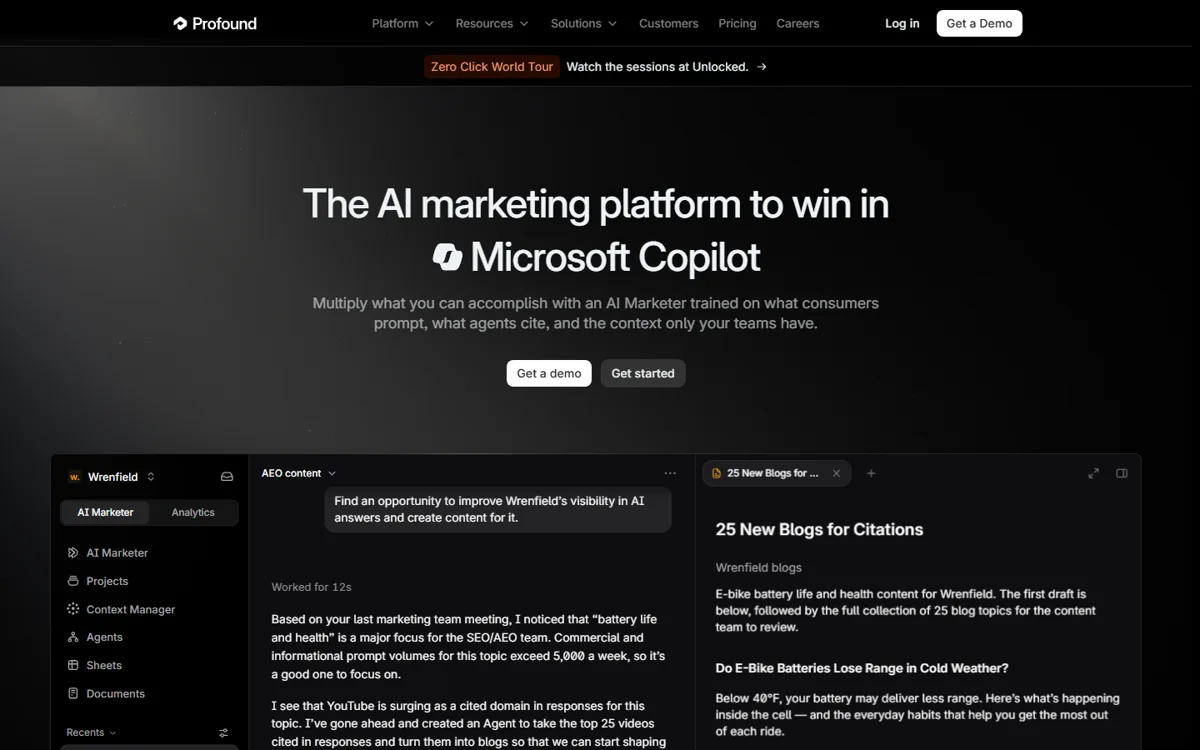
Profound is an AI marketing platform for answer engine optimization (AEO), sold mainly through Enterprise contracts. It pairs tracking with prompt-volume data, AI crawler analytics, and content agents.
On the tracking side, it runs structured prompts across AI platforms. It reports where and how your brand appears, with citations, sentiment, ranking, and competitive presence.
How Profound works:
- Tracks visibility, citation share, sentiment, and competitive presence daily.
- Reports Prompt Volumes for the topics you track.
- Reads AI crawler activity through Agent Analytics, with integrations for Akamai, AWS, Cloudflare, Fastly, Google Analytics and WordPress among others, and runs content agents on credits.
Engines and collection
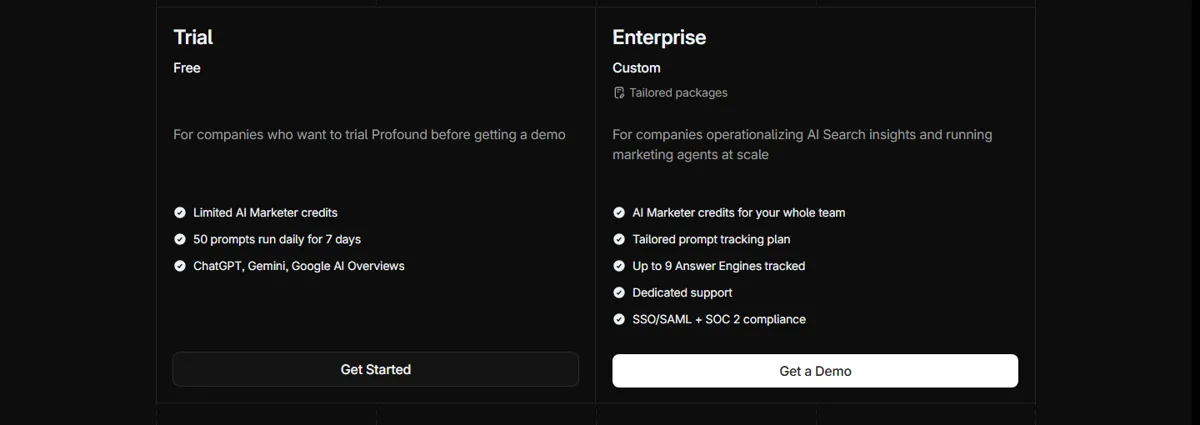
Profound’s trial runs on ChatGPT, Gemini and Google AI Overviews. Enterprise tracks up to nine answer engines: ChatGPT, Perplexity, Google AI Mode, Gemini, Microsoft Copilot, DeepSeek, Claude, Google AI Overviews and Exa Search.
Profound pricing as of November 2026
- Trial: free for seven days, 50 prompts run daily
- Enterprise: by quote
- Agency Growth: self-serve, with 10 pitch workspaces a month and 400 credits a month per client workspace. Client workspaces are a $399-a-month add-on with 100 prompts each, and five extra trial workspaces cost $199 a month
Trial and Enterprise seats are unlimited.
Profound strengths
- Prompt Volumes shows which topics come up in AI conversations, so you can choose prompts by demand.
- Agent Analytics ties AI crawler activity to human visits from AI search, which links AI search visibility to traffic.
- Seats are unlimited, and Enterprise includes SSO.
Profound limitations
- Tracking up to nine answer engines and SSO are Enterprise features.
- Enterprise requires a quote, so comparing its cost with other tools needs a sales call.
- Content agents run on credits, so their usage is metered separately from tracking.
3. Otterly AI: Best for small teams and freelancers on a budget
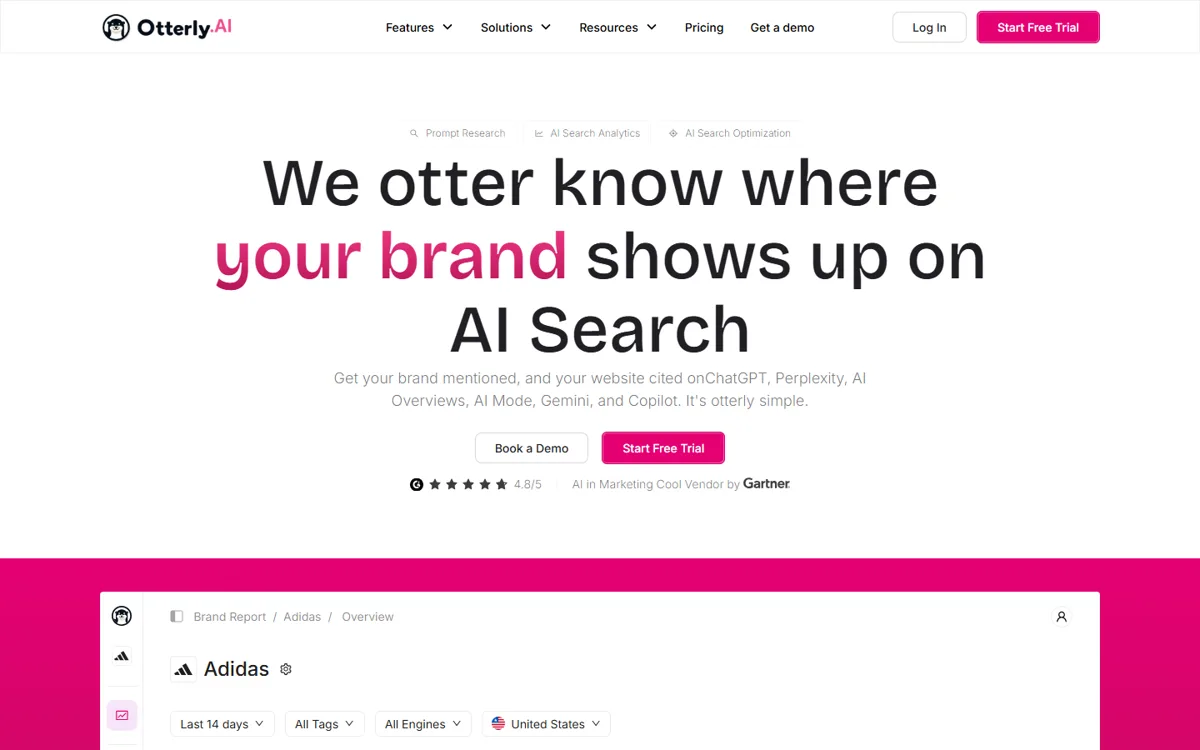
Otterly AI monitors a small prompt set daily across four base engines, starting from a $29 entry plan. It also adds page-level generative engine optimization (GEO) audits.
How Otterly AI works:
- Tracks brand visibility, sentiment, and citation sources daily on every paid plan.
- Lets you build a prompt library of buyer questions, with a prompt research tool and a query fan-out tool that shows the related searches an AI engine runs behind a question.
- Audits URLs for AI readability (1,000 a month on Lite, 5,000 on Standard, 10,000 on Premium) and adds API, MCP, a Data Studio connector, and Agent Analytics from Standard.
Engines and collection
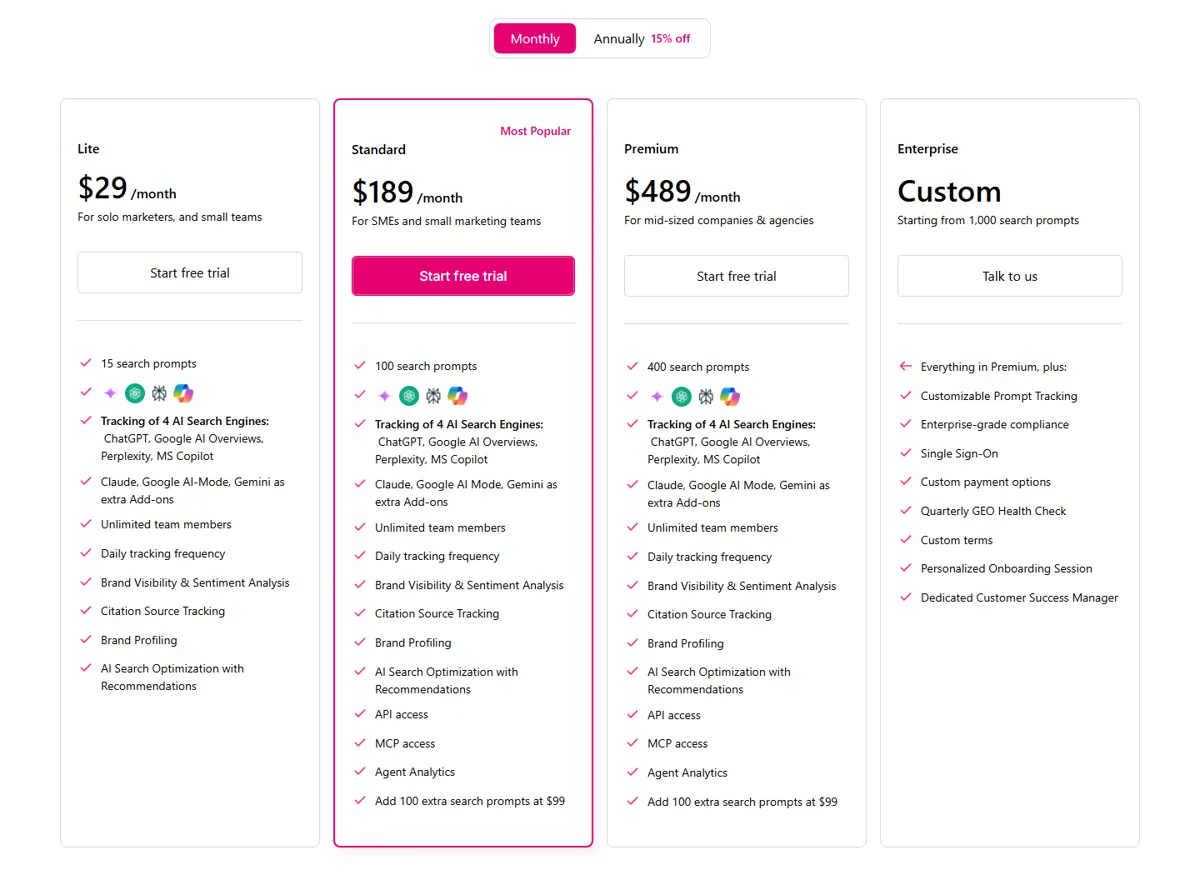
Every Otterly plan tracks ChatGPT, Google AI Overviews, Perplexity, and Microsoft Copilot. But Google AI Mode, Gemini, and Claude are paid add-ons.
Otterly AI pricing as of November 2026
- Lite: $29/month for 15 prompts and one workspace
- Standard: $189/month for 100 prompts
- Premium: $489/month for 400 prompts
- Enterprise: custom from 1,000 prompts
Plans bill monthly or annually in US dollars, and the prices above are the monthly ones.
Google AI Mode and Gemini each cost $9, $59, or $149 a month extra on Lite, Standard, or Premium, and Claude costs $29, $109, or $439. Standard and Premium can add 100 prompts for $99, up to 300 extra on Standard.
Otterly AI strengths
- The $29 Lite plan is the second-lowest entry price here, after ziptie.ai’s smallest preset.
- Team members are unlimited on every plan, and workspaces are unlimited from Standard, so headcount and client count don’t drive the price.
- Page-level audits check how readable your URLs are to AI engines, up to 1,000 a month on Lite.
Otterly AI limitations
- Google AI Mode, Gemini, and Claude are paid add-ons, and Claude on Premium adds $439 a month to a $489 plan.
- API, MCP, the Data Studio connector, and Agent Analytics start on Standard, so Lite has none of them.
- Lite includes 15 prompts and can’t add more, because only Standard and Premium can buy 100-prompt packs for $99.
4. Semrush AI Visibility Toolkit: Best for teams already on Semrush
Semrush’s AI Visibility Toolkit adds AI tracking inside the Semrush SEO platform, with research reports on any brand and daily tracking of your own prompts.
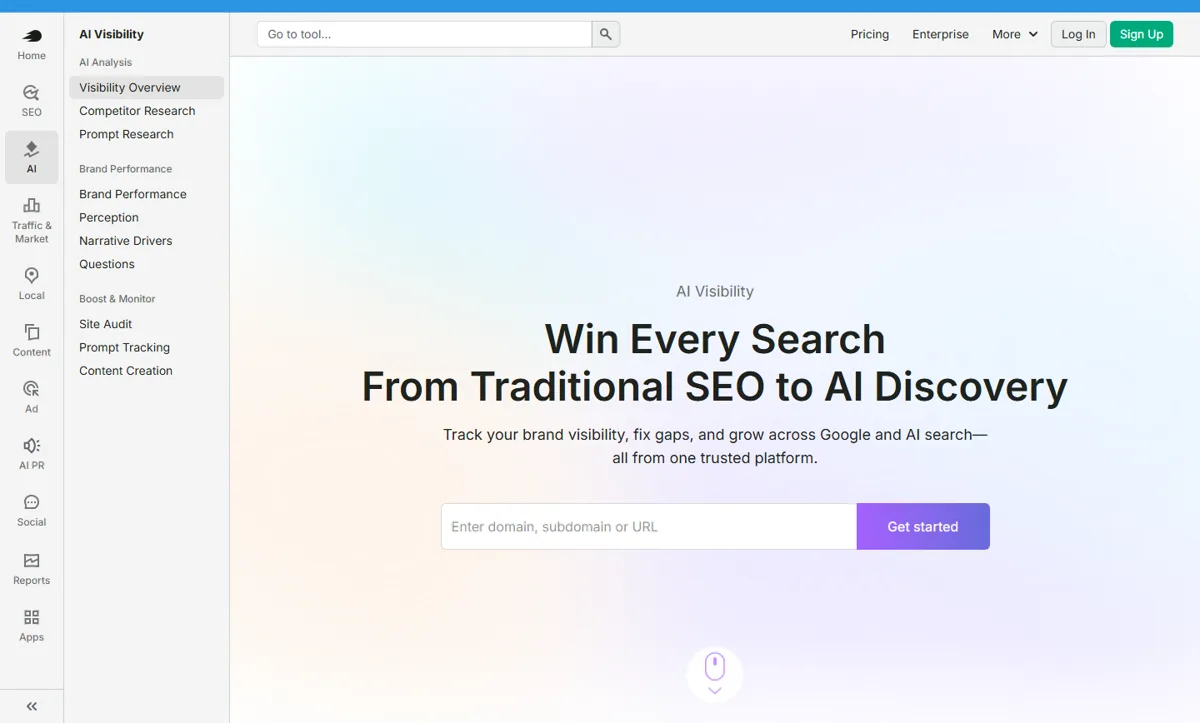
How the Semrush AI Visibility Toolkit works:
- Reports a Visibility Overview, Competitor Research, and Prompt Research from a Semrush database of more than 317 million prompts and responses.
- Runs Brand Performance weekly on Semrush-chosen queries, and tracks your own prompts daily in Prompt Tracking.
- Checks up to 100 pages for AI-crawler issues in an AI Search Site Audit. CSV exports across the toolkit run up to 1,000 rows, ten a day per user.
Engines and collection
Semrush tracks ChatGPT, Gemini, Google AI Overviews and AI Mode, and Brand Performance adds Perplexity.
For its research reports, it captures responses from real requests rather than LLM APIs. It describes its metrics as directional, so treat them as signs of movement, not exact measures.
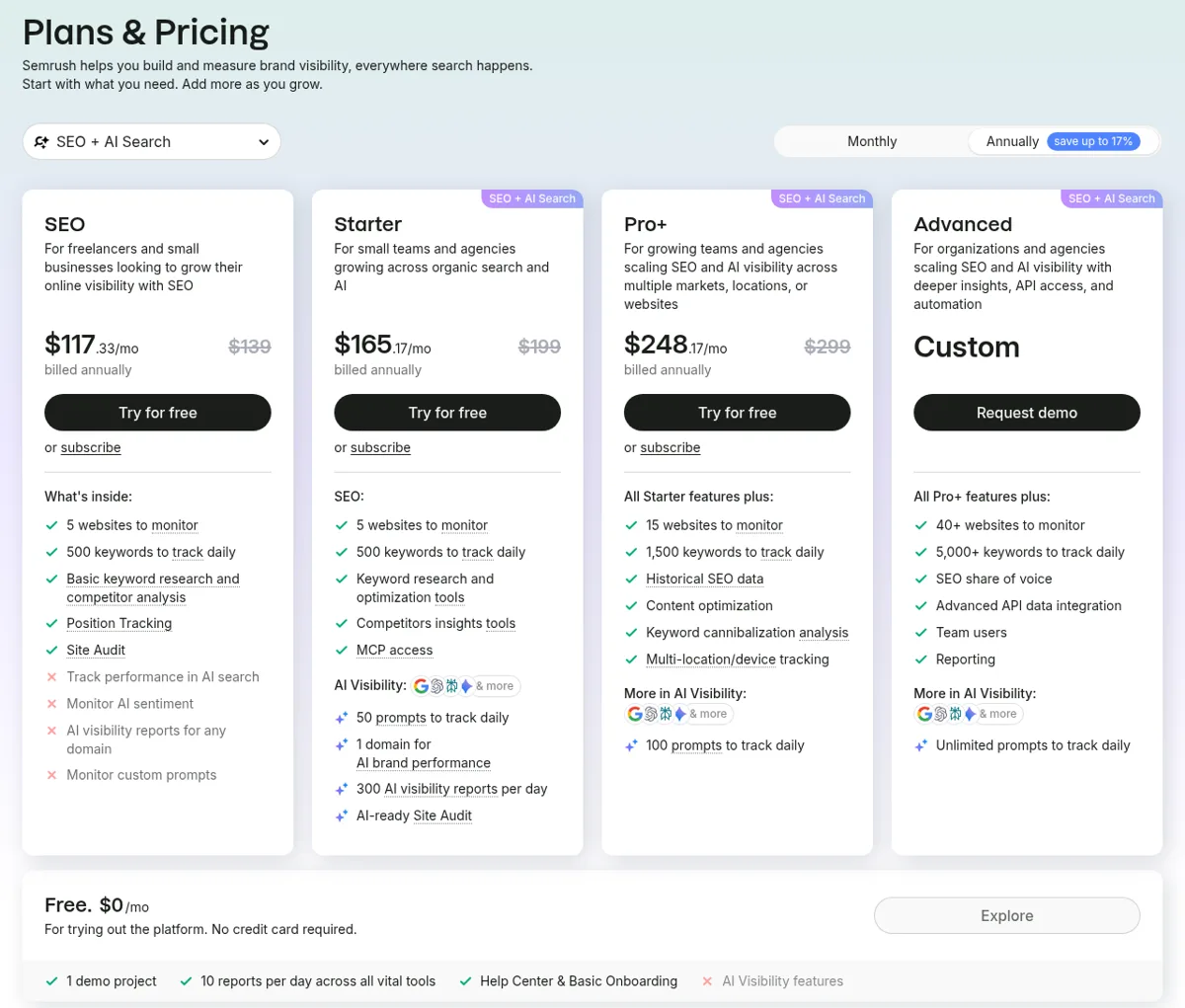
Semrush AI Visibility Toolkit pricing as of November 2026
- Standalone toolkit: $99 per month for one project, one domain in Brand Performance, and 25 tracked prompts
- SEO + AI Search plans: Starter tracks 50 prompts, and Pro+ tracks 100, refreshed daily
Fifty more prompts cost $60 a month, an extra domain $99, and each additional user a $99 license. There’s no free trial on the toolkit.
Semrush AI Visibility Toolkit strengths
- LLM visibility data sits next to keyword, backlink, and audit data on one login.
- Research reports cover any brand from a database of more than 317 million prompts, and your own prompts refresh daily.
- Semrush captures research-report responses from real requests, not LLM APIs.
Semrush AI Visibility Toolkit limitations
- The standalone toolkit includes 25 tracked prompts, and each extra 50 prompts costs $60 a month.
- Every additional user needs a $99 license, and every extra domain costs $99, so team and client growth raises the bill.
- Brand Performance refreshes weekly, and only Prompt Tracking runs daily.
- The toolkit covers five engines, so teams that need others have to add another tool.
5. Ahrefs Brand Radar: Best for competitor and category research without setup
Ahrefs Brand Radar is an AI visibility index built from Ahrefs’ keyword database, so you can look up any brand’s AI visibility immediately. Custom Prompts add daily tracking of the questions you choose.
The index suits brands that already appear in AI answers. Custom Prompts suit niches too specific to show up in it.
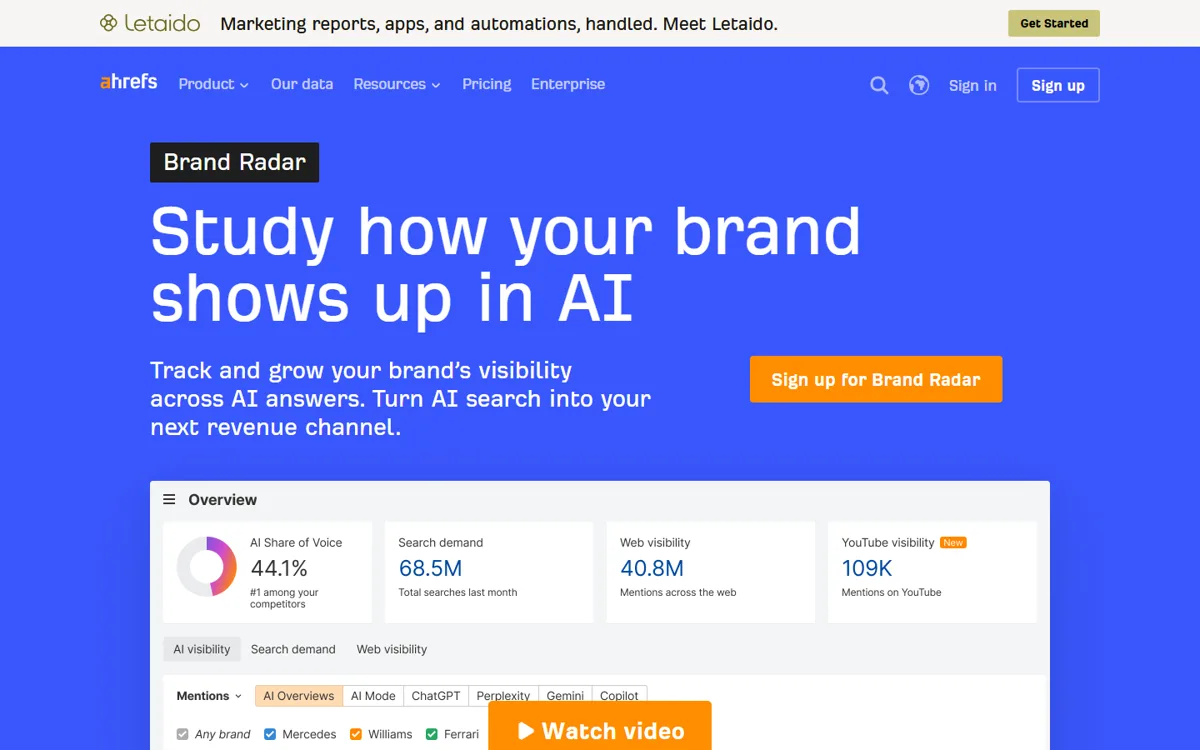
How Ahrefs Brand Radar works:
- Runs more than 525 million prompts through AI platforms and stores every response. It builds them from keywords in its database, then expands them with People Also Ask questions and fan-out.
- Reports mentions, citations, AI share of voice, and estimated impressions weighted by search volume. Index history goes back to 2025, and Custom Prompts data starts the day you add the prompt.
- Tracks the prompts you define through Custom Prompts, reports YouTube, TikTok, and Reddit visibility in beta, and exposes data through the API and MCP.
Engines and collection
Ahrefs’ index covers AI Overviews, AI Mode, ChatGPT, Perplexity, Gemini, and Copilot. Answers come from the web version of each chatbot on its default model.
Custom Prompts add Claude, but each Claude update uses 8 checks instead of 1. Ahrefs re-tests the index’s question sets monthly on a 90-day reporting window, and Custom Prompts run daily, weekly, or monthly.
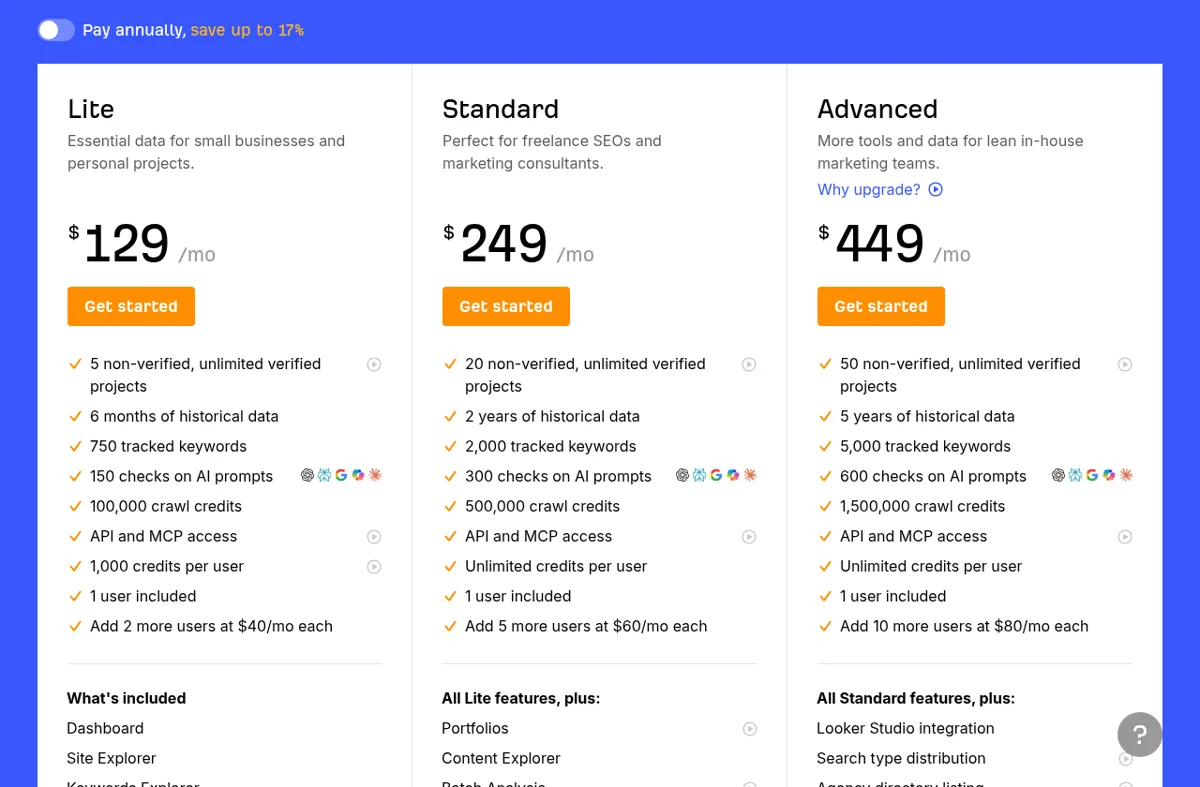
Ahrefs Brand Radar pricing as of November 2026
- Custom Prompts: from $50/mo for 2,500 checks
- Ahrefs Lite ($129/mo) and above: 150, 300 or 600 checks a month, enough for 5, 10 or 20 daily prompts on one platform
- AI Visibility Index: $199/mo for one platform, or $699/mo for all platforms with 2,500 custom prompt checks included
Brand Radar sells standalone with an Ahrefs Free account, and one check is one prompt on one platform in one location. Ahrefs publishes a free AI Visibility Checker.
Ahrefs Brand Radar strengths
- You can look up any brand or category without setup, which gives a fast competitive benchmark.
- Index prompts are tied to known search volume, so you can weight results by demand.
- A free AI Visibility Checker gives you a baseline without paying.
Ahrefs Brand Radar limitations
- Claude is available only through Custom Prompts, and each Claude update uses 8 checks instead of 1.
- From Lite up, Ahrefs caps Custom Prompts checks at 150, 300, or 600 a month, which covers 5, 10 or 20 daily prompts on one platform.
- Ahrefs re-tests the index monthly, so changes appear with a lag, and only Custom Prompts can run daily.
- The $199 index plan covers one platform, and all platforms cost $699 a month.
- Ahrefs builds index prompts from keyword data, not from observed AI conversations.
6. Scrunch: Best for teams that want site audits alongside tracking, with AI-crawler delivery on Enterprise
Scrunch combines prompt monitoring with site audits on its Core plan. On Enterprise, it also serves AI agents a machine-readable version of your pages.
How Scrunch works:
- Monitors prompt results and the citations behind them, with sentiment and up to five competitors on Core.
- Runs site audits (five a month on Core), page optimizations (one a month on Core), and persona and funnel-stage tagging, and estimates topic-level AI search volume for three topics on Core.
- On Enterprise, it serves AI agents an optimized version of your pages through its Agent Experience Platform.
Engines and collection
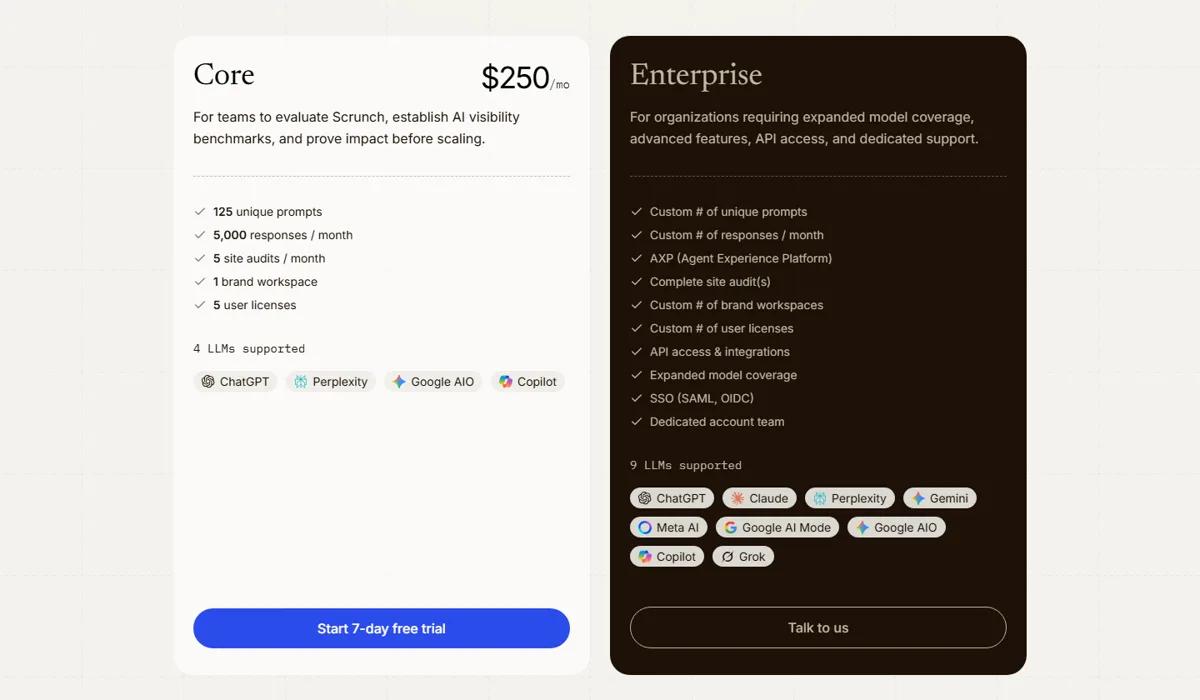
Scrunch Core tracks ChatGPT, Perplexity, Google AI Overviews, and Copilot and includes 5,000 responses a month. Enterprise adds Claude, Gemini, Meta AI, Google AI Mode, and Grok.
Scrunch pricing as of November 2026
- Core: $250/mo for 125 prompts, 5,000 responses, five site audits, one brand workspace and five user licenses, with a 7-day free trial
- Enterprise: adds API access, Looker Studio, and SAML or OIDC SSO
Scrunch strengths
- Site audits and prompt tracking come in one plan, so you don’t need a second tool.
- Prompts can be tagged by persona and funnel stage, which lets you group results by buyer journey.
- SOC 2 Type II compliance helps with security reviews.
Scrunch limitations
- Core tracks four engines, and Claude, Gemini, Meta AI, Google AI Mode and Grok are Enterprise-only.
- API access, Looker Studio, and SAML or OIDC SSO are Enterprise-only.
- Serving AI agents an optimized version of your pages is an Enterprise feature.
- Core includes one brand workspace and five site audits a month.
7. AthenaHQ: Best for the widest engine list on a self-serve plan, if you budget for credits
AthenaHQ is a credit-based platform whose paid tier tracks eleven AI models. It reports prompts, responses, sources, competitors, and sentiment, then recommends on-page and off-page actions.
How AthenaHQ works:
- Includes a content optimization agent and estimates prompt volume for your topics.
- Connects to GA4, Google Search Console, Webflow and Framer, with Shopify catalog optimization and Tableau, Power BI and Looker on Enterprise.
Engines and collection
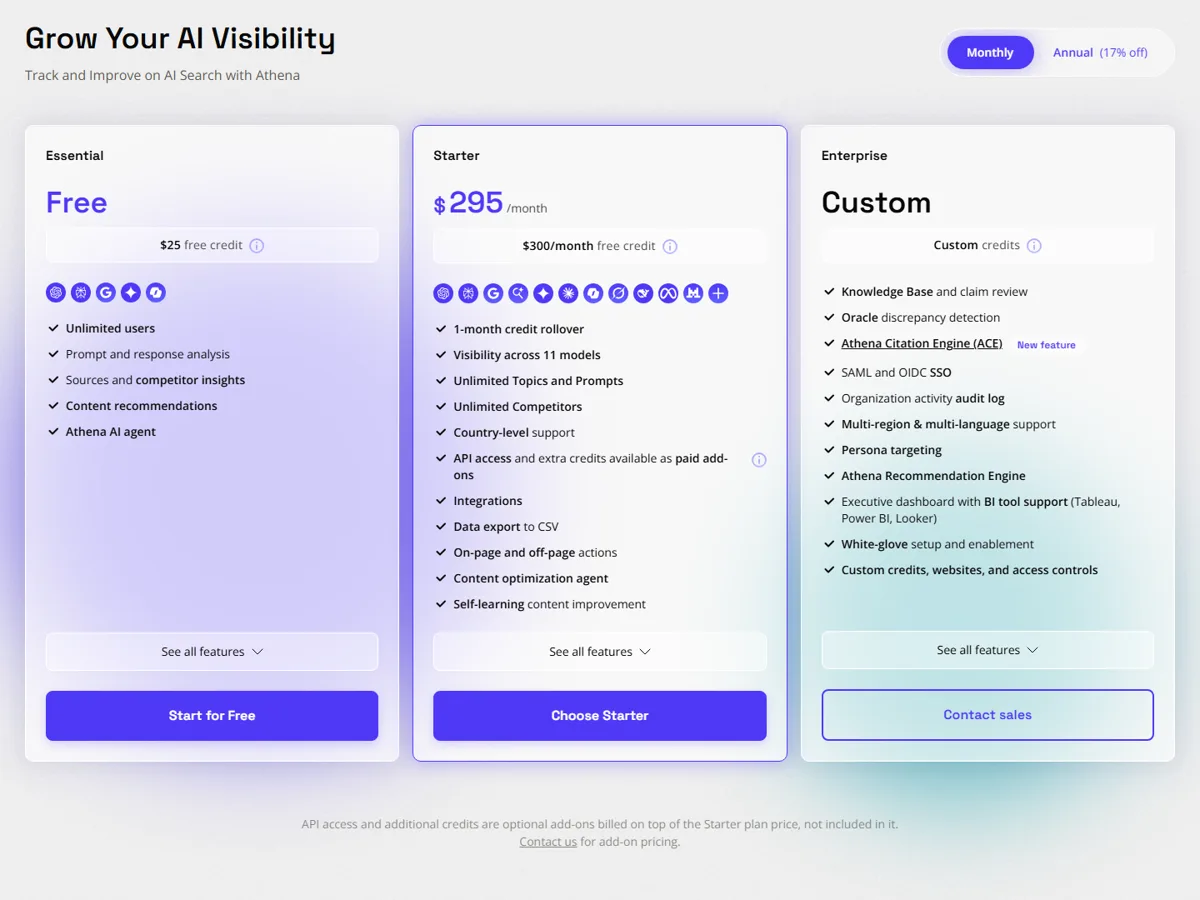
AthenaHQ’s free Essential plan covers ChatGPT, Perplexity, AI Overviews, Gemini and Copilot. Starter adds Google AI Mode, Claude, Grok, DeepSeek, Meta AI, and Mistral, for 11 models in total.
AthenaHQ pricing as of November 2026
- Essential: free with 300 credits
- Starter: $295/month as listed, with 3,600 credits, where one credit is one AI response on the standard engines and five on Claude, Grok, DeepSeek, Meta AI and Mistral, unlimited topics, prompts and competitors, and country-level support; annual billing takes 17% off
- Enterprise: custom
API access and extra credits are add-ons priced on request.
AthenaHQ strengths
- The paid tier covers 11 models, the widest engine list on a self-serve plan here.
- The free Essential plan tracks five engines with 300 credits, so you can test it before paying.
- Seats are unlimited, and the GA4 and Search Console connections let you tie AI visibility to site traffic.
- SOC 2 Type II and GDPR compliance help with security reviews.
AthenaHQ limitations
- Credits run out faster than the headline suggests: Claude, Grok, DeepSeek, Meta AI and Mistral cost 5 credits per response, and prompt expansion multiplies every response by 4.
- API access and extra credits are add-ons priced on request.
- Tableau, Power BI, and Looker connections need Enterprise, and Shopify catalog optimization needs Enterprise or Agency.
- Starter covers one country, and multiple regions and languages need Enterprise.
8. SE Visible: Best for teams on SE Ranking, or that want API and MCP access on an entry plan
SE Visible is SE Ranking’s standalone AI visibility product. SE Ranking’s Core and Growth plans also include a small allowance of it: 25 prompts, one project, and one location.
How SE Visible works:
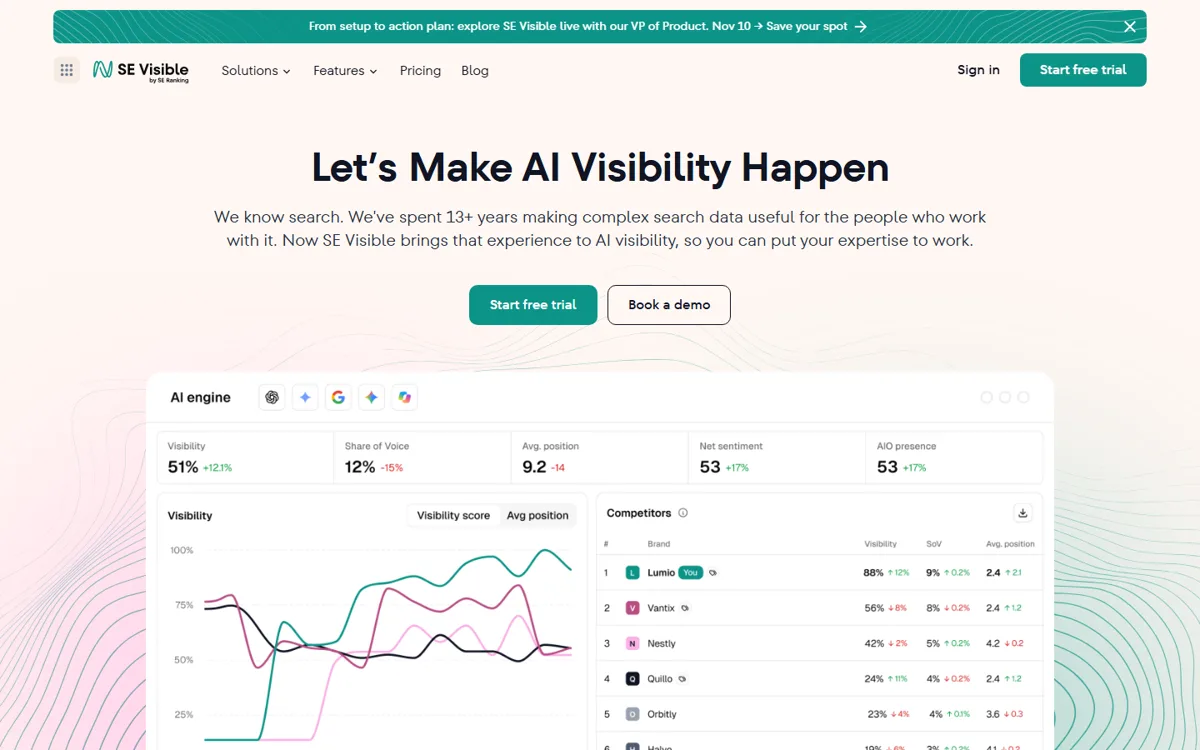
- Reports visibility, share of voice, average position, and net sentiment on one dashboard, refreshed daily, and opens the unedited AI answer behind any number.
- Tracks your prompts in topics with localized suggestions, and ranks pages that cite competitors but not you.
- Includes a Data Studio connector, API access, and MCP access on every listed plan, and lets agencies give clients a login that shows only their brand.
Engines and collection
SE Visible tracks ChatGPT, AI Overviews, AI Mode, and Gemini through a browser and graphical interface. It records answers as a user sees them in the app or on Google Search, including the links the AI cites.
SE Visible pricing as of November 2026
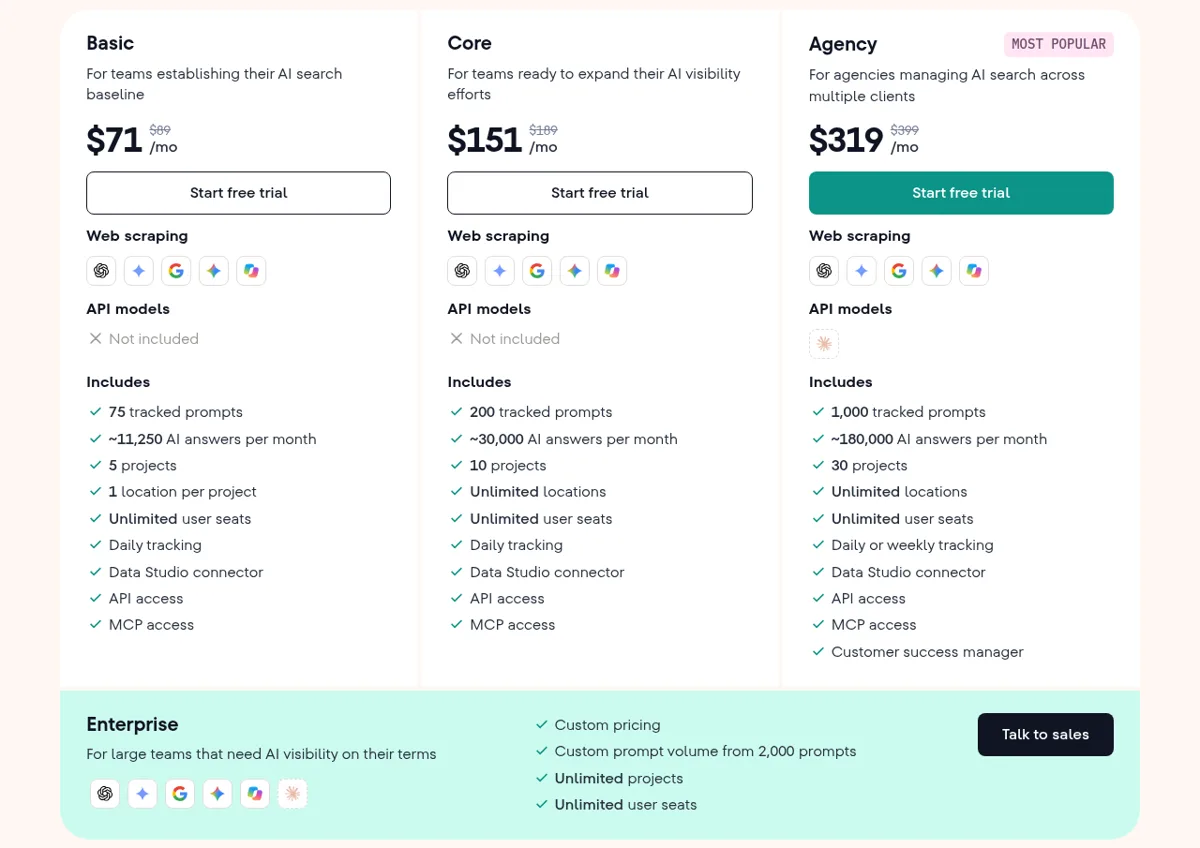
- Basic: $89 a month for 75 tracked prompts, five projects and one location per project
- Core: $189 for 200 prompts and ten projects with unlimited locations
- Agency: $399 for 1,000 prompts, 30 projects, and a customer success manager. White-labeling sits in SE Ranking’s separate Agency Pack, not SE Visible.
- Enterprise: custom from 2,000 prompts
Annual billing is cheaper, and seats are unlimited. Each location counts as a separate prompt. You also get a 10-day free trial.
SE Visible strengths
- It records answers as a user sees them in the app or on Google Search, including the links the AI cites.
- The entry plan refreshes daily and includes API and MCP access.
- Seats are unlimited on every plan.
SE Visible limitations
- Basic includes one location per project, and each extra location counts as a separate prompt.
- White-labeling isn’t part of SE Visible, because it sits in SE Ranking’s separate Agency Pack.
9. Writesonic: Best for content teams that want tracking and production in one tool
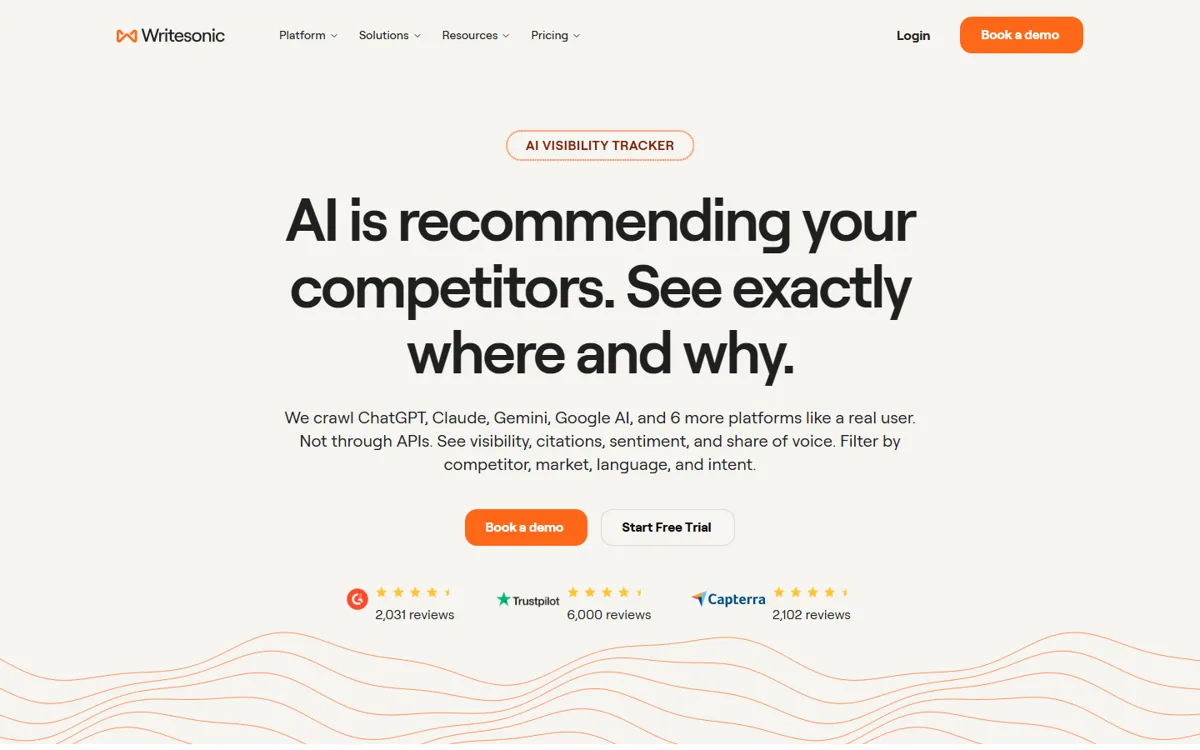
Writesonic is an AI content platform with a visibility module that tracks prompts, audits pages and drafts or updates content in the same product. It collects answers by crawling the AI interfaces the way a user does, not through APIs.
How Writesonic works:
- Tracks prompts daily with visibility and citations, adds sentiment from Growth, and filters by competitor, market, language, and intent.
- Monitors ChatGPT and Google AI ads on every plan, and ChatGPT Shopping on Enterprise.
- Audits sites and writes AI articles on a monthly allowance, with an Action Center of prioritized fixes: a trial of five off-page and five on-page actions a month on Growth, full access on Enterprise.
Engines and collection
Starter to Growth track ChatGPT, Gemini and Google AI Overviews. Enterprise tracks all nine platforms, including Perplexity, Claude, Grok, Copilot, and Google AI Mode, and crawls each interface daily.
Its data sources include Keyword Planner, Google SERPs, and Reddit, and Search Console connects as an integration.
Writesonic pricing as of November 2026
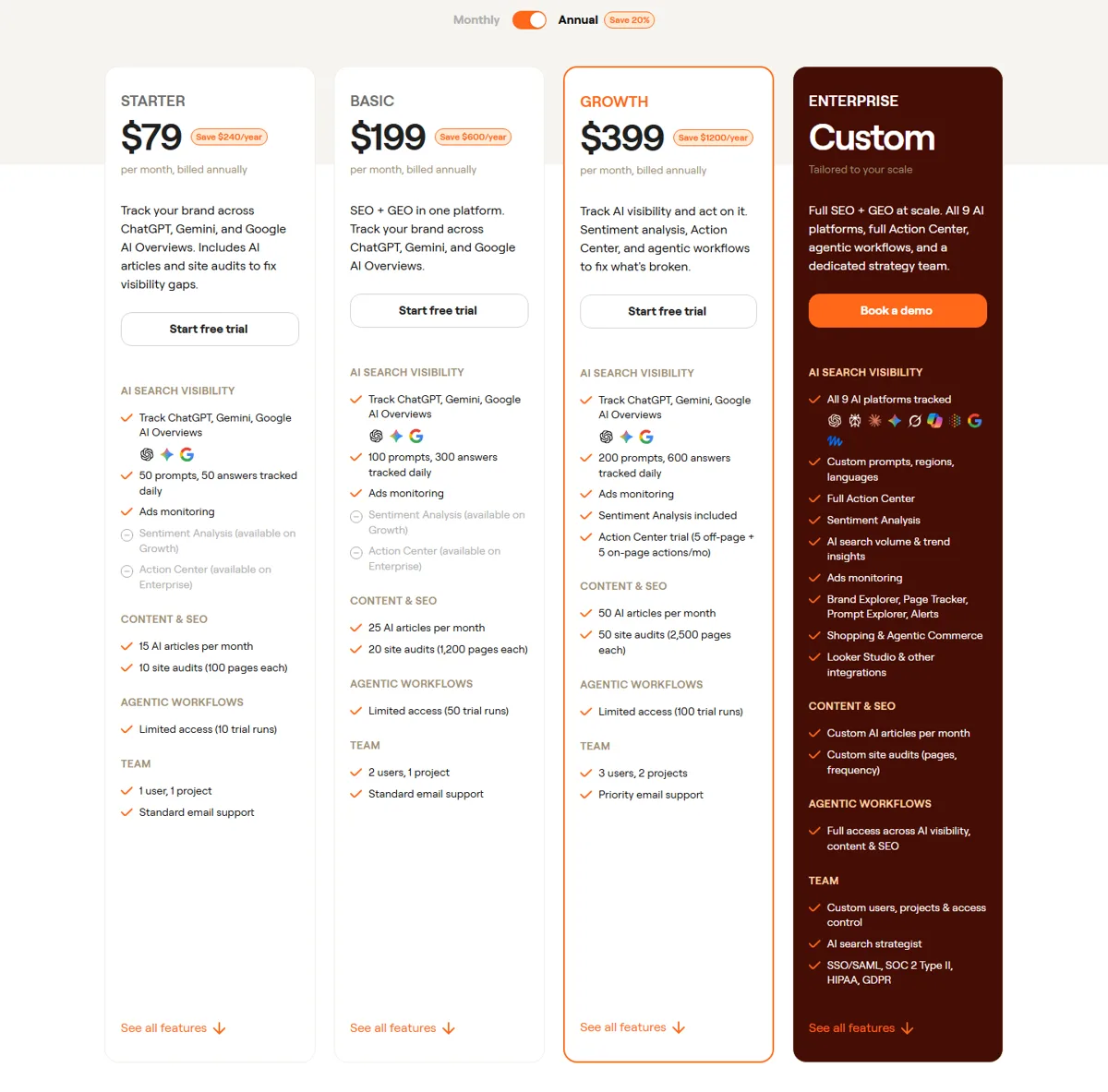
- Starter: $79 per month billed annually for 50 prompts, one user, and 15 AI articles a month
- Basic: $199 per month billed annually for 100 prompts, two users and 25 AI articles a month
- Growth: $399 per month billed annually for 200 prompts, three users and 50 AI articles a month
- Enterprise: custom, with SOC 2 Type II, HIPAA, GDPR, and SSO
Sentiment analysis starts on Growth. There’s a 7-day free trial with no card.
Writesonic strengths
- Content and tracking share one plan, and Starter includes 15 AI articles a month.
- Ads monitoring for ChatGPT and Google AI is included on every plan.
- Its published method records answers as a user sees them in the AI interface.
Writesonic limitations
- Plans below Enterprise track ChatGPT, Gemini, and Google AI Overviews only, and Perplexity, Claude, Grok, Copilot, and Google AI Mode need Enterprise.
- Sentiment analysis starts on Growth.
- The full Action Center of prioritized fixes is Enterprise-only, and Growth includes five off-page and five on-page actions a month.
- Brand Explorer and ChatGPT Shopping monitoring are Enterprise-only.
10. ziptie.ai: Best for agencies that want to pay by prompt, with no seat or project limits
ziptie.ai tracks brand visibility across up to seven AI search engines, depending on your country and the engines you run. It shows which answers mention and cite you. It’s the newer platform from the team behind ziptie.dev, which still runs as a separate product.
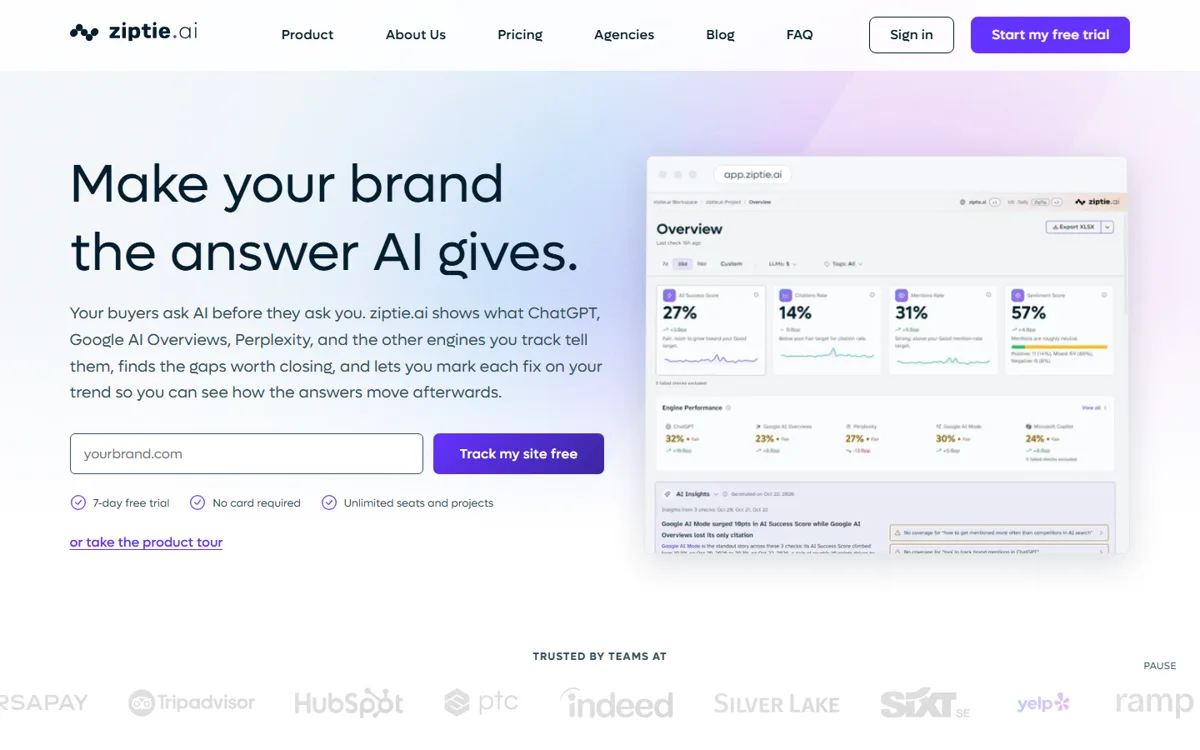
How ziptie.ai works:
- Records brand mentions, citations, and sentiment per check, with the full answer and cited-source list stored.
- Checks registered brand facts against answers to flag contradictions, and captures the top ten organic results on Google and Bing AI Overview checks at no extra cost.
- Exports to CSV, Excel, and PDF, produces white-label client reports and public share links on every plan, and connects to Google Search Console read-only.
Engines and collection
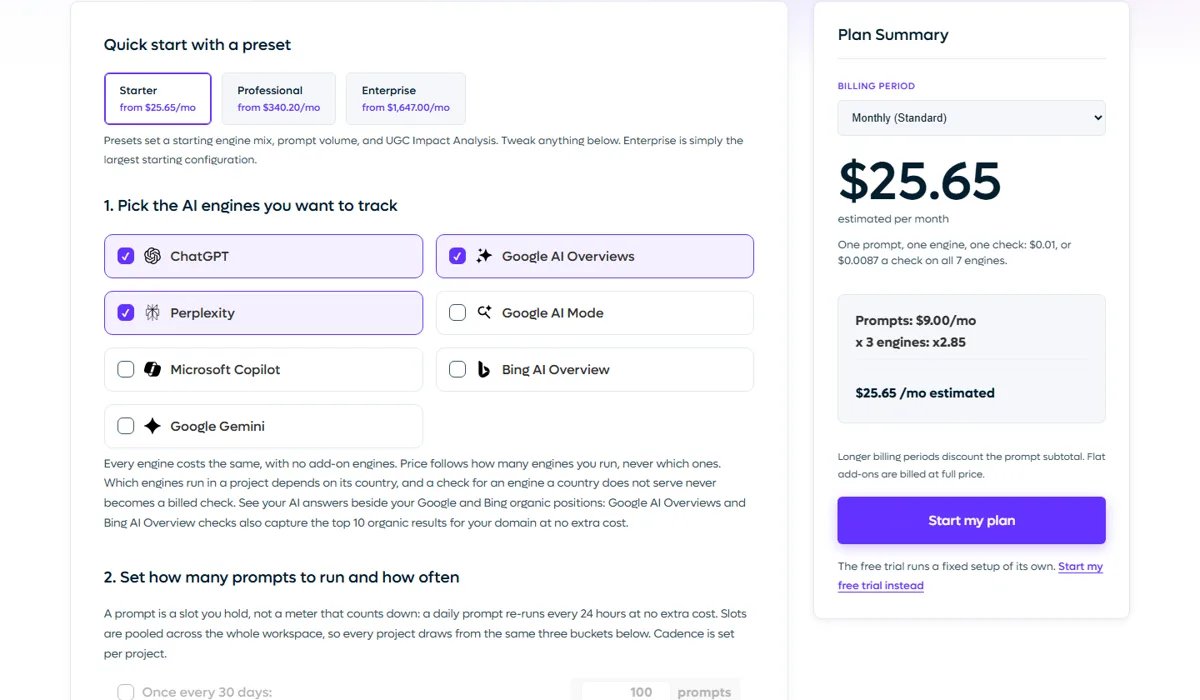
ziptie.ai tracks ChatGPT, Google AI Overviews, Perplexity, Google AI Mode, Microsoft Copilot, Bing AI Overview, and Google Gemini. Every engine costs the same, with no add-on engines.
It captures every engine through AI-answer data providers, which submit your monitored prompts with the project’s country and return the public answer and its citations.
It declines to publish a position-in-answer number by design. That fits SparkToro’s finding that position in an AI answer isn’t a reliable measure. You set the cadence per project: every 1, 7 or 30 days.
ziptie.ai pricing as of November 2026
- Per check equivalent: $0.01 for one prompt on one engine, or $0.0087 per check on all seven. You pay for prompt slots by cadence, so a daily prompt re-runs at no extra charge.
- Starter preset: from $25.65/mo
- Professional preset: from $340.20/mo
- Enterprise preset: from $1,647.00/mo
A worked example of 50 daily, 300 weekly, and 1,000 monthly prompts on all seven engines comes to $230.95 a month before add-ons, or $184.76 paid yearly. Seats, projects, and competitors are unlimited, and there are no overage charges.
Add-ons are UGC Impact Analysis at +80%, content generation at $20 a month per context, and API and MCP access at $10 a month. UGC Impact Analysis shows the Reddit threads, YouTube videos, and other user-generated content AI engines cite.
ziptie.ai strengths
- Pricing is per check, and every engine costs the same.
- Seats, projects, and competitors are unlimited, and white-label reports are included on every plan.
- The public methodology states what the tool can’t measure.
ziptie.ai limitations
- It can’t report AI crawler hits or AI referral sessions because it records only what the engines publicly say.
- API and MCP access cost $10 a month extra.
- UGC Impact Analysis (+80%) and content generation ($20 a month per context) are add-ons.
- Auto-suggested prompts come with the UGC Impact Analysis add-on, which adds 80% to the prompt cost.
Which AI visibility is best for you?
Your existing SEO suite and the number of brands you track narrow the list fastest.
- Already on Semrush, Ahrefs, or SE Ranking: start with that suite’s AI module and check its engines against where your buyers ask. Semrush tracks five engines, SE Visible tracks ChatGPT, AI Overviews, AI Mode and Gemini, and Ahrefs tracks Claude only through Custom Prompts.
- Agency with several client brands: compare projects and client reporting before pricing. Profound sells client workspaces as a $399-a-month add-on, Scrunch has Agency Core at $500, and SE Visible Agency covers 30 projects for $399. Otterly and ziptie.ai offer unlimited workspaces or projects.
- Small team or freelancer: a low-prompt plan is enough for a baseline. Otterly Lite tracks 15 prompts for $29 a month, and AthenaHQ Essential is free. Adding Claude, AI Mode, and Gemini takes Otterly Lite from $29 to $76.
- Enterprise team that runs AI search as its own program: weigh prompt-volume data, crawler analytics, and security requirements. Profound combines Prompt Volumes and Agent Analytics with SSO on Enterprise, and Scrunch Enterprise covers nine engines, five more than Core.
- Content team that wants production in the same tool: Writesonic combines tracking and AI article writing on one bill.
Final thoughts
If you already pay for a suite, test its AI module before buying anything else. If you don’t, getting started with AI visibility means using the free Google and Bing reports, writing your prompt set, and running one tool for 30 days with weekly re-runs.
Then act on the cited sources. They show which pages the engines pull from. To show up in AI answers, you can publish pages that answer the buyer’s question directly, or earn a place on the third-party pages already cited.
If you need help with the first, take a look at my content writing services.
FAQ
What is an AI visibility platform?
An AI visibility tool sends a set of prompts to AI engines like ChatGPT, Perplexity and Google AI Overviews on a schedule. It reports whether your brand was mentioned, whether your pages were cited, and how you compare with competitors.
Some also audit whether AI crawlers can read your pages. A rank tracker measures your position in a list of links, while an AI visibility tool reads a written answer.
What is the best tool for tracking AI visibility?
Peec AI suits marketing teams that want to choose their engines, Profound suits enterprises, and Otterly AI suits small budgets. If you already use Semrush, Ahrefs or SE Ranking, start with that suite’s own module.
Engine coverage, collection method, and prompt source differ across all ten, so scores from two tools won’t match even on the same prompts.
What can an AI visibility score tell you?
A visibility score shows how often your brand appeared in a vendor’s prompt sample on a given day, not what buyers typed.
SparkToro’s January 2026 study found a less than 1 in 100 chance that ChatGPT or Google’s AI would return the same brand list in any two of 100 responses.
Its author concluded that a visibility percentage over many prompts is reasonable, while a ranking position in AI is not. Watch the trend and the cited URLs.
Why can a visibility score change when your content hasn’t?
Tool settings and Google’s AI features both shift. In Graphite’s August 2026 research, ChatGPT prompts that never trigger web search on their own showed visibility values 20 points apart, depending on whether the tool forced a search.
In Conductor’s 2026 analysis of 274.5 million US searches, AI Overview share went from 23% in September 2025 to 47% in January 2026, then 34% in February. A falling score may mean Google shows fewer AI Overviews.
How can you check your AI visibility for free?
Three free checks give you a baseline of your AI visibility without a paid tool: Google Search Console’s generative AI reports, Bing Webmaster Tools’ AI Performance report, and a manual run of your own buyer prompts logged in a spreadsheet.
Ahrefs also offers a free AI Visibility Checker, and AthenaHQ’s Essential plan runs five engines on 300 free credits.
What do Google’s and Bing’s free AI reports show?
Google’s Search Generative AI performance reports reached all sites worldwide by 31 August 2026. They show impressions for your URLs in AI features on Search and Discover.
AI Performance in Bing Webmaster Tools, in public preview since 10 February 2026, shows total citations, cited pages, and grounding queries across Copilot and Bing’s AI summaries. Bing says its query data is a sample. Neither covers ChatGPT or Perplexity.
How do you check your AI visibility in ChatGPT, Perplexity and Gemini?
Write the questions a buyer would ask before knowing your name, such as “best [category] for [situation]”, and skip branded wording. Run each one repeatedly in each engine, then record which brands appear and which URLs get cited.
SparkToro’s January 2026 research recommended running a prompt at least 60 to 100 times before averaging, which is a lot of runs to do by hand.
How often should you track AI visibility?
When tracking AI visibility, run a fixed prompt set at least weekly, because results vary from run to run and a trend needs repeated readings. Daily tracking gives you more readings, so a change shows up sooner.
Peec runs every prompt every 24 hours; ziptie.ai lets you set 1, 7, or 30 days, and Ahrefs re-tests its index monthly while Custom Prompts run daily, weekly, or monthly.
How much do AI visibility tools cost?
AI visibility tools range from free plans to enterprise contracts priced by quote as of November 2026. Free options include AthenaHQ Essential and the Ahrefs checker.
Entry plans run from about $25 a month on ziptie.ai’s smallest preset and $29 on Otterly Lite to $295 on AthenaHQ Starter. Suite products start at $50 for Ahrefs Custom Prompts and $99 for the Semrush toolkit.
Do you still need an AI visibility tool if you use Semrush or Ahrefs?
You don’t need a separate tool if the suite module covers the engines your buyers use and refreshes often enough for your reporting.
Semrush’s toolkit tracks five engines and refreshes Brand Performance weekly. Ahrefs includes 150 to 600 Custom Prompts checks a month from Lite up, while its index re-tests monthly. Teams that need Claude or Copilot, daily chat-interface data or more prompts add a dedicated tracker.
Is SEO dead now that AI answers exist?
SEO still matters, because ranking pages earn a sizable share of AI Overview citations. In Ahrefs’ March 2026 analysis of 863,000 keyword SERPs, 37.9% of cited URLs also appeared in the first ten SERP blocks.
Ahrefs’ July 2025 study, which counted only the top three citations, put the share at 76%. The studies count differently, so the drop isn’t a like-for-like comparison. Marie Haynes’s 2026 analysis of 100 websites found that ChatGPT sessions were 0.62% of Google organic volume.
