
In this guide, I will explain what search intent is, why Google treats it as the foundation of relevance, and how you can optimize your content to give users what they actually want.
I will show you how intent shapes search engine results pages (SERPs), how Google evaluates it, and what format your content needs so it stands a chance of ranking.
I’ve pulled everything here directly from real research, SERP studies, and Google’s own documentation, not guesswork.
Key takeaways (TL;DR)
- Search intent is the reason behind a query and the first thing Google evaluates before ranking content. Google’s documentation makes this clear: understanding search intent is essential for relevance.
- The four types of search intent are informational, navigational, commercial, and transactional, but real SERPs often show mixed or fractured intent when users searching expect multiple outcomes.
- Google uses its internal model (Know, Know Simple, Do, Website, Visit-in-Person) to classify intent and shape the SERP with features like snippets, shopping ads, videos, and map packs.
- Matching user intent is more important than keyword density or backlinks. Real case studies show how pages jumped to number one just by realigning with what the user wanted.
- AI Overviews reward structured, concise content that answers search queries clearly, includes original insight, and satisfies complex informational or commercial intent.
- Before targeting any keyword, you must confirm what users expect by checking SERP formats, modifiers, and country-specific behavior, especially for US vs. UK searches.
- Content ranks when it matches user expectations better than anything else on the page. It fails when the format, tone, or angle does not align with intent, even if it is high-quality.
What search intent means for your strategy
Search intent is the underlying purpose behind a search query.
It describes why someone searches. For example, someone may Google “best running shoes” because they want to compare models, and someone else “buy Nike Air Max size 10” because they are ready to purchase right now.
Google uses this purpose as the foundation for relevance.
Before it evaluates keywords, backlinks, or on-page optimization, it determines what the searcher is trying to accomplish. This is why the same keyword can return different search engine results depending on context, location, device, and even time.
A search for “pizza” on a phone at 6 pm signals a different type of search intent than the same search on a desktop mid-morning.
The search engine also uses its own internal intent model — Know, Know Simple, Do, Website, and Visit-in-Person — to classify queries and build SERPs around them. Informational queries get guides or snippets. Transactional queries get shopping ads and product page results. Local queries trigger map packs.
With AI systems in play, Google can interpret search intent with far more nuance than before. It now uses neural matching and LLM-based reasoning to understand latent user needs, not just literal keywords.
Why search intent is crucial for SEO success
Search intent matters because SEO is no longer about matching keywords but user expectations.
Google rewards pages that satisfy user intent quickly, clearly, and completely.
Content that aligns with what searchers want consistently ranks better, earns more engagement, and gets surfaced more often in AI Overviews. Content that does not match intent is filtered out.
There are plenty of real-world cases that prove this.
An Ahrefs product page saw a 516% traffic increase after the team added a free tool to match the true intent behind “backlink checker.”
Google’s Helpful Content system reinforces this. It rewards content that satisfies user needs and demotes content that fails to do so. Understanding search intent plays a central role in how Google judges usefulness.
Finally, intent impacts engagement signals like dwell time or bounce rates.
These are not direct ranking factors, but they are strong indicators that users got what they came for. If your article is the wrong format or answers the wrong question, users return to the SERP — and that’s a clear signal you didn’t meet their search intent.
The four main types of search intent
Google surfaces different intent of content depending on what it believes the user wants. Most queries fall into four types of search intent.
Informational intent
This is when users want to learn something. These queries often include words like “what,” “how,” “why,” or “guide.” Someone searching “how to start a vegetable garden” wants a step-by-step explanation. Someone asking “what is a DSLR camera” wants a clear definition.
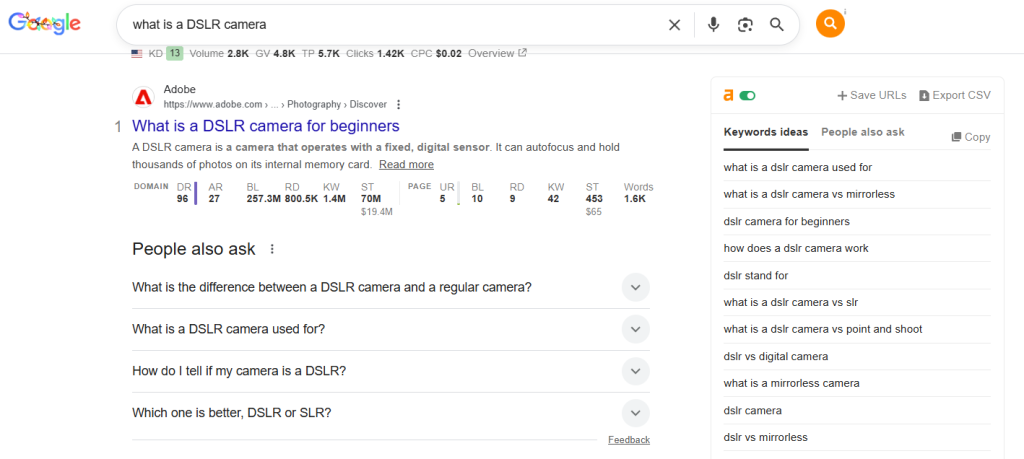
Within informational intent, Google splits queries into Know and Know Simple.
Know Simple queries are answered directly on the SERP or inside AI Overviews because users expect a short, factual answer like “height of the Eiffel Tower.” Know queries require depth, structure, and expertise.
Navigational intent
This is when users want to reach a specific website, page, or platform. Searches like “Facebook login” or “Moz DA tool” tell Google the user already knows where they want to rank.
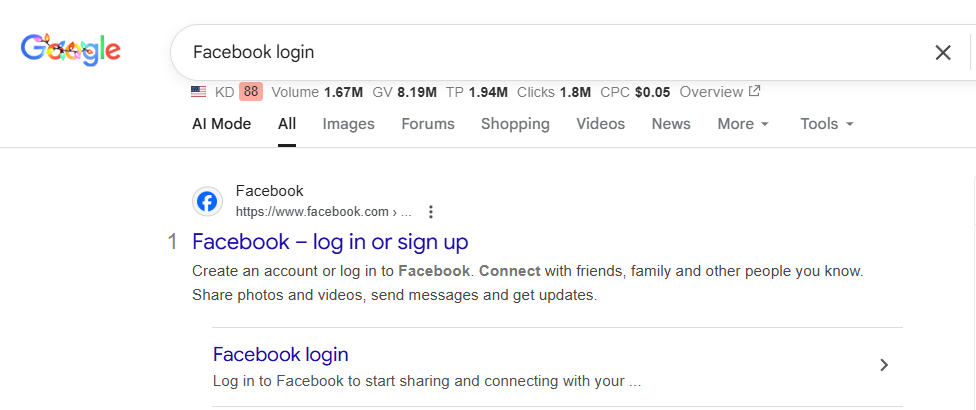
Navigational intent also reinforces brand authority. A high volume of navigational searches signals strong entity trust, which Google uses as an authority indicator.
It is almost impossible to outrank the brand itself for its navigational terms, which is why SEOs target “alternatives” or “competitors” pages instead.
Commercial intent
Commercial intent sits between education and purchase. Users want to compare products, evaluate options, or find the best solution. Queries like “best gaming laptop 2025,” “X vs Y,” or “best freelance b2b saas writers” belong here.
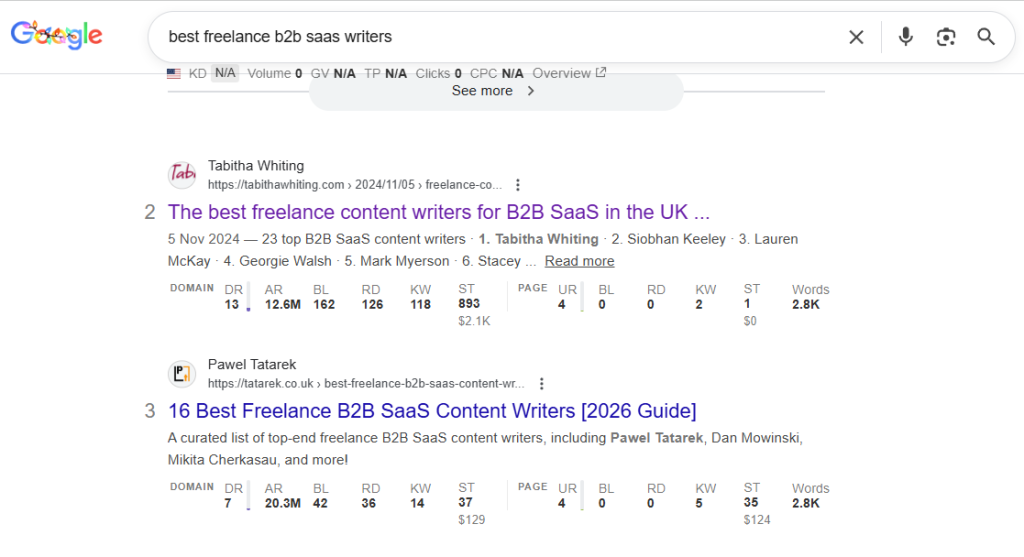
Commercial intent investigators expect depth, comparison, and real insight. So unique data, original analysis, and specific examples that go beyond generic listicles.
Many of these users who search for commercial terms land on a dedicated product page or category page.
Transactional intent
Transactional intent appears when users are ready to take immediate action.
They already understand their options. They’re not comparing or researching anymore. Their goal is to buy something, sign up for something, book something, or visit a specific location.
Google classifies most of these as Do or Visit-in-Person queries.
Users searching “buy HP laptop” or “cheap flights to Berlin,” want a fast, frictionless path to conversion.
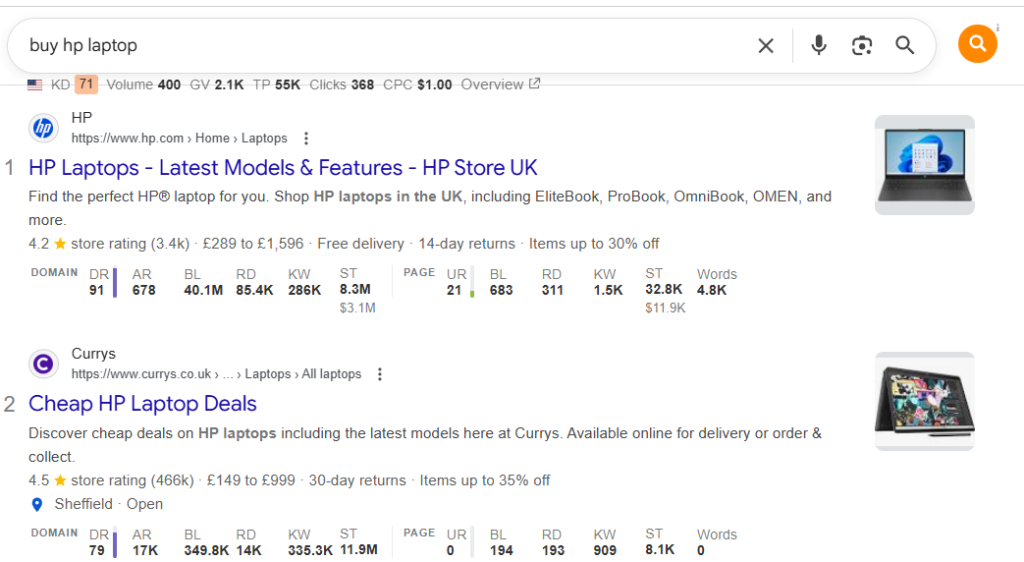
That’s why these SERPs often include shopping ads, product grids, and category pages. Google pushes these elements high on the page because they satisfy the user’s goal with fewer clicks.
My workflow: how to determine search intent
Search intent looks obvious in hindsight, but predicting it correctly requires a process. Most intent mismatches happen because someone chose a keyword without studying what Google actually shows for it. Here’s the workflow I use before I outline any article.
1. Analyze the current SERP
The fastest and most reliable way to identify search intent is to search the keyword and study the first page of results.
Google has already done the hard work of interpreting the query. All you need to do is read what it’s telling you.
Check what dominates the top positions. If you see listicles, the user wants comparisons. If you see how-to guides, the intent is informational. If you see shopping ads or product page results, the intent leans commercial or transactional.
Look at SERP features:
- A featured snippet usually appears for informational search intent queries.
- Shopping ads or carousels signal a purchase-driven query.
- A map pack signals local action (“visit-in-person” intent).
- Mixed search results often reveal fractured intent — where users have different expectations and show inconsistent behavior. For example, the keyword “blog editing” returns a mix of guides and listicles, so the intent is informational/commercial.
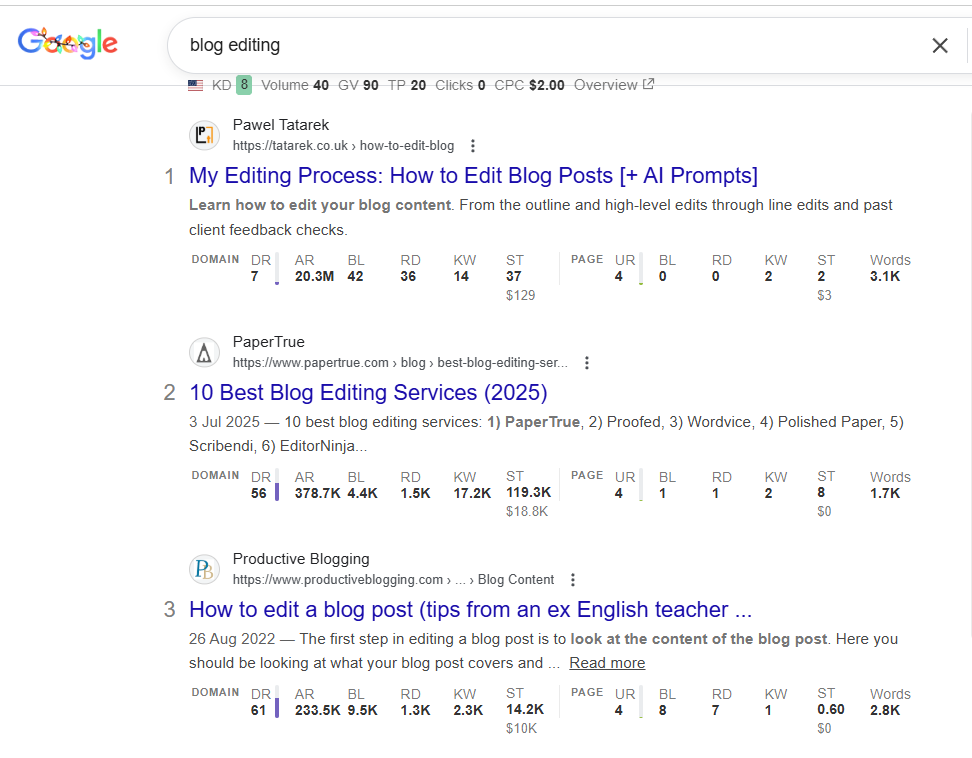
SERP analysis gives you the dominant interpretation of the keyword, not your personal interpretation. That’s the part many people search and skip, and it’s why their content struggles.
2. Study the wording of the keyword
Keyword modifiers reveal a lot about what the user expects:
- Words like “how,” “what,” and “why” indicate informational intent. “
- Best,” “review,” “compare,” and “top” indicate commercial investigation.
- “Buy,” “order,” “download,” and “coupon” lean transactional.
The research compares “dog food ingredients” with “ingredients for dog food.”
The first suggests learning what goes into a product.
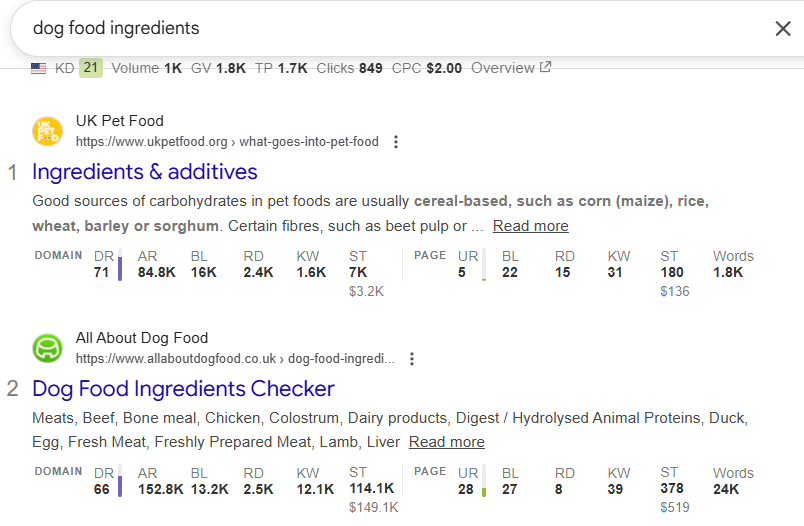
The second returns some of the same pages but also more recipes. The query looks similar, but the user’s goal is not always the same.
3. Use SEO tools to classify the query
Most modern SEO tools now label keywords with intent types. Semrush, Moz, and Ahrefs all use intent classifications as part of keyword research.
These labels are helpful when you are dealing with hundreds of keywords, but they are not perfect.
Tools can misclassify mixed or ambiguous queries, especially when SERPs include blended formats. And they tell you very little about the ranking content.
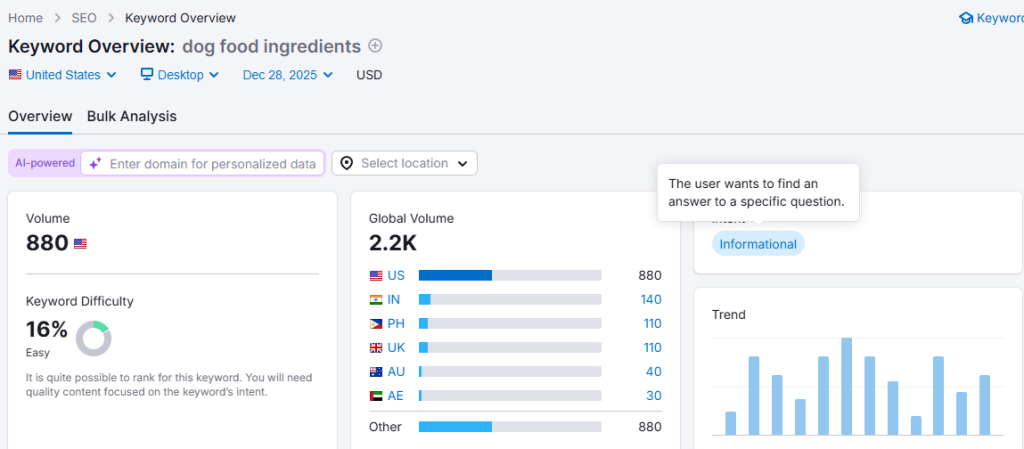
Use them as a starting point, then validate through manual analysis.
4. Consider context, location, and device
Intent shifts based on where and when the search happens. The research example about “pizza” illustrates this perfectly — the same query means something different on a mobile device at 6 pm than on a desktop at 10 am.
Local intent also varies by country.
The UK often uses boroughs, neighborhoods, and postcodes instead of “near me” queries. US users rely more heavily on city-level or county-level searches.
If you are doing international SEO, you can’t assume the US SERP applies to the UK. You must check both, because Google behaves differently depending on user behavior patterns.
How AI and modern SERPs changed search intent
Search intent is not new, but the way Google interprets it has dramatically.
The shift started with machine learning, accelerated with neural matching, and went mainstream once Google introduced AI Overviews.
Today, intent is not just a category — it’s a set of layered signals driven by user behavior and LLM reasoning.
AI Overviews and answer-based SERPs
Google’s AI Overviews now appear at the top of the page for 21% of all keywords — mostly informational ones, but the ratio of commercial and transactional queries is increasing. These summaries push traditional organic results down the viewport, which changes the strategy. Ranking first in the blue links is no longer enough. You also need to be the source Google cites in its overview.
To earn those citations, your content must be structured in a way LLMs can easily extract.
Initial research shows that Google prefers 40- to 60-word answer snippets that appear immediately under a heading. Q&A formatting and clean, structured paragraphs make extraction easier.
Zero-click behavior also affects which queries are worth targeting.
Simple fact-based searches are answered directly in the overview, leaving no incentive for the user to click. The opportunity lies in complex queries where the overview can only give a surface-level summary.
How AI interprets intent with more nuance
LLMs allow Google to understand the latent meaning behind a query, not just the literal keywords. The system recognizes shades of commercial investigation, urgency, hesitation, and ambiguity.
Mixed intent is also more visible now. Some SERPs show listicles, product cards, videos, map packs, and long-form guides all at the same time. When that happens, Google is signaling that the audience has multiple motivations.
As a result, content that covers several formats — such as a guide with a comparison table and a short embedded video — often performs better because it satisfies more slices of that fractured intent.
The need to engineer content for multiple intent layers
Google’s behavior has become less linear.
Instead of a single dominant intent, you often see dominant, common types of search intent, and minor intent coexisting on one page.
A query like “Apple” could refer to the company, the fruit, product news, or recipes. Each layer attracts a different audience segment.
If your target keyword consistently shows this kind of SERP volatility, you can’t rely on a single format. You either:
- Target the dominant intent directly,
- Build a hub page that branches into different intent types, or
- Create content that covers multiple expectations on one page.
This is where the “kitchen sink” approach becomes useful for freshly fractured SERPs. When Google is unsure, it prefers pages that de-risk the search by giving users multiple pathways.
How to optimize content for search intent
Optimizing for search intent is not about adding keywords. It’s about aligning your content with what users expect to see when they search that query. If the format, structure, and angle don’t match the SERP, nothing else matters. Here’s how I approach this before drafting anything.
1. Match the content type, format, and angle
The top-ranking pages already show what Google believes satisfies the user best. If every result is a listicle with comparison tables, the user wants a comparison — not an opinion piece, and not a product page.
If the SERP is full of how-to guides, then your article needs steps and structure. This is the essence of the Three Cs: content type, content format, and content angle.
One example from the research illustrates this perfectly: a page about “SEO strategy” underperformed because it focused on a single tactic, even though the SERP showed users expected a full framework covering multiple strategies.
I use the same approach when ideating content. I study the first five to ten results and reverse-engineer what Google is rewarding.
It’s not copying. It’s understanding the intent behind what the user clicked into these pages to find.
2. Cover the full scope of user needs
Good content answers the main query. Great content anticipates follow-up questions. Searchers rarely want a single piece of information. They want the surrounding context, the steps, the edge cases, and the details.
The “People Also Ask” questions and and Reddit discussions usually reveal these follow-ups. The top-ranking articles also expose recurring subtopics you must include to stay competitive. Covering the full scope increases “information gain,” which makes your content more valuable and more likely to be cited in AI Overviews.
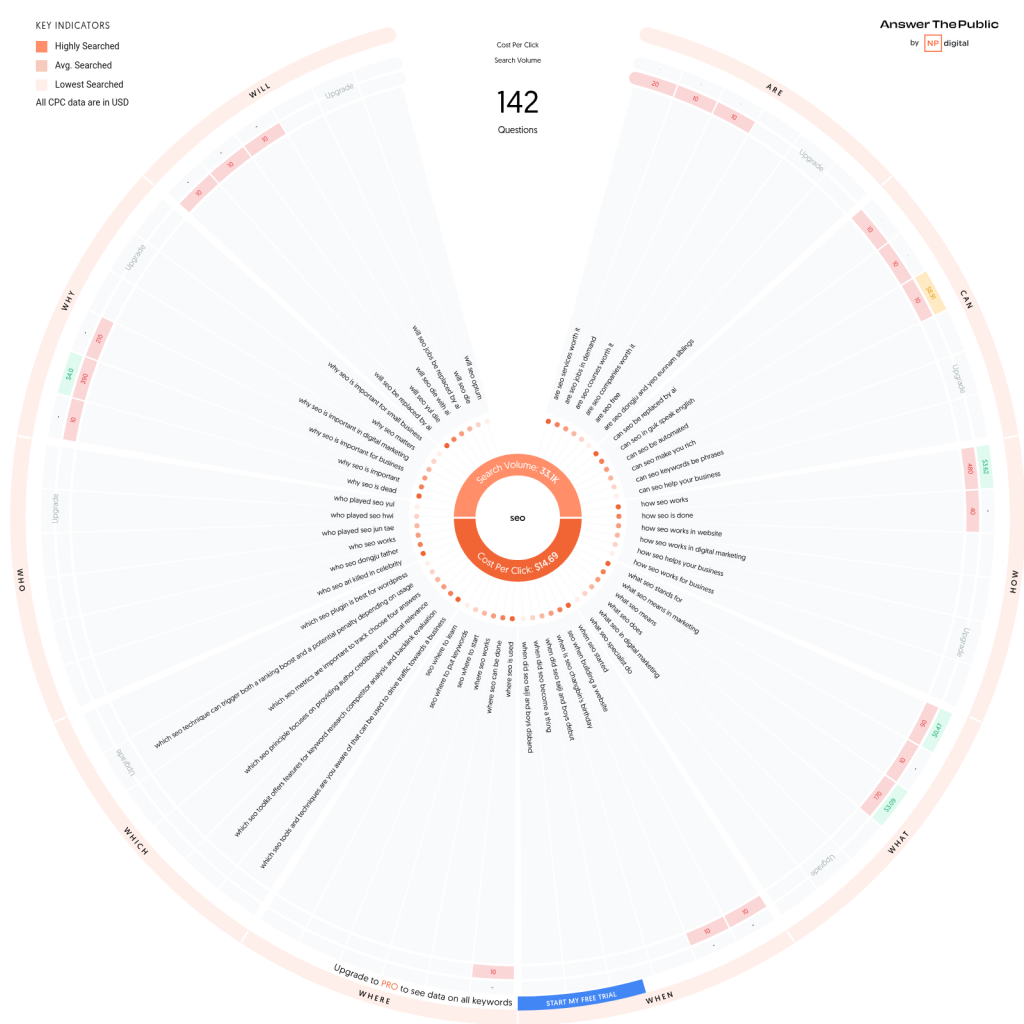
This completeness also reduces bounce rates, because users don’t need to reopen the SERP to fill knowledge gaps.
3. Demonstrate expertise and original insight
Google’s guidelines reward content that shows experience, credibility, and authority. It’s not enough to summarize existing pages. You need to add something unique — examples, original research, real-world takeaways, or personal experience.
When Google compares two pages that satisfy intent, it gives an edge to the one with stronger E-E-A-T signals.
In commercial intent queries, this matters even more. Users want insight that goes beyond generic reviews, so Google gives weight to content that shows testing data or a differentiated perspective.
Whenever possible, I bring in my own experience or client examples. AI-generated summaries can’t replicate that, and Google is actively looking for signals of real authorship and first-hand expertise.
4. Make the content easy to navigate
Users skim before they commit. If the page doesn’t look like it will answer their question quickly, they leave.
Clean headings, short paragraphs, bullets, and scannable formatting help users find what they need immediately.
This also helps Google extract content for snippets and AI Overviews. Visuals, tables, and diagrams help with informational intent because they condense complex explanations into something more digestible.
The structure depends on the intent:
- Guides need steps.
- Commercial content needs comparisons.
- Category pages need filtering options.
- Local pages need location and NAP data.
- Hybrid pages need clear internal navigation.
Matching UX to intent is as important as matching the words.
5. Optimize titles and descriptions for intent
The title tag and meta description tell users whether your page matches what they’re looking for. A mismatch here means low click-through rates, even if your ranking is strong.
Transactional queries need decisive wording like “buy,” “order,” or “deals.” Informational queries need clarity, not clickbait. Commercial intent queries perform better with numbers or comparison signals, because that’s what users expect to see.
If ten of the top pages use a similar stylistic pattern in their titles, that pattern reflects user search intent preference. I usually mirror the pattern while adding something unique that sets my angle apart.
6. Map the query to the user journey
Search intent aligns with different funnel stages.
Informational intent queries belong to the awareness stage. Commercial queries belong to consideration. Transactional queries belong to decision.
This should influence your CTAs.
For TOFU pieces, educational resources or internal links make sense. For BOFU intent, the CTA should push the user toward a product, demo, or sign-up.
When the CTA matches the user’s goal, conversion rates go up.
Common search intent mistakes to avoid
Even experienced SEOs make intent mistakes that tank their rankings. These are the ones I see most often.
1. Publishing the wrong format for the SERP
This is the number-one reason content fails. If the SERP is full of listicles and you publish a narrative essay, Google will not rank it. If the SERP is full of product page results and you publish a blog post, you won’t stand a chance.
The SERP already tells you the expected format. Anything else feels irrelevant to Google and confusing to the user.
2. Targeting keywords without checking for mixed intent
Some queries contain multiple interpretations. The SERP responds by blending product pages, guides, videos, and map packs. If you don’t notice this, you’ll build the wrong asset and miss the dominant intent entirely. The research describes this as fractured intent, where Google hedges its bets because users want different things.
If the SERP is unstable or mixed, you either target the dominant slice or use a hybrid format. Ignoring this always leads to under-performance.
3. Writing content that’s too shallow for the query
Informational queries that fall under the Know category require depth. They need explanations, examples, and structure. If you publish a thin article, users go elsewhere to fill the gaps.
4. Assuming intent is the same across countries
US and UK users behave differently. The research notes that UK users prefer deeper research and hyper-local specificity, while US users tend to move through the funnel more quickly.
If you use one version of a page for both markets, you’ll miss expectations in at least one of them.
5. Ignoring context and device
Mobile can imply a different intent than desktop. Location can change the meaning entirely. Time of day can shift local queries toward immediate action.
People forget that Google personalizes intent interpretation based on these signals. Ignoring context results in a mismatch between what users expect and what your content provides.
Final thoughts
Search intent is the backbone of modern SEO. It decides what the SERP looks like, which pages rank, how AI Overviews summarize information, and what users expect when they arrive on your site.
When your content matches that intent precisely, everything else becomes easier. Rankings improve, clicks rise, engagement strengthens, and your content feels immediately relevant.
Most SEO problems I see today come back to intent mismatches. People create content that is great for the wrong expectations. They write a guide when the SERP wants a comparison. They publish a listicle when the user is ready to buy. They aim for informational intent when the audience wants a tool.
When you reverse that mindset and start with intent, the entire content strategy becomes more effective — and more predictable.
If you want help creating SEO-optimized content that aligns with search intent and actually ranks, get in touch and let’s build something that works.
