“Top X alternatives” or “best tools for X” listicles make up 20-30% of the 650+ blog posts I’ve written for B2B SaaS companies and SEO agencies. Over the last 12 months, it’s probably closer to 50%.
Such listicles are popular because they rank for branded keywords and move customers down the funnel. And recently — get cited in AI search results.
In this article, I will show you how to write high-quality listicles that rank in SERPs, get quoted in AI answers, and most importantly — help readers make the right decision.
No fluff, just useful, practical tips, illustrated with examples.
How to write a bottom-of-the-funnel listicle step by step
Here’s the process I follow when I write listicles, from research and outlining through drafting, editing, and optimization.
Click any step to expand the detail.
Confirm the search intent by checking ranking articles
SERP CheckThe keyword tells you it’s a BOFU listicle — but not much more. Plug it into Google and study what’s ranking.
Look at how many items they cover, how they’re structured, how detailed the descriptions are, and what they’re missing. That’s your baseline to improve on, not a template to replicate.
Define the audience
PersonaBOFU readers are usually comparing products. But if your tool serves multiple personas, you need to pick one.
Sometimes the keyword itself tells you (“best e-commerce platforms for small business”). If not, confirm with the content manager or target the content gap that gives you the best ranking chance.
Determine the buyer’s needs and constraints
Pain PointsResearch what pain points the product solves, why people choose it over alternatives, and what’s missing.
Best sources: content manager insights, user interviews, sales and support transcripts, published case studies, customer reviews on G2 and Capterra, and unfiltered feedback on Reddit.
Research the right products to include
ShortlistLook for products that tick the boxes. Dig deep into why each is a good — or bad — choice.
Product website (pricing, features, case studies), Reddit and Quora for unfiltered feedback, G2 / Capterra / Clutch for reviews, YouTube for in-depth demos. Rate each product against your criteria as you go.
Outline the listicle and review the supporting data
OutlineSettle on the final list, organize items into categories, and choose the exact details to include.
If a detail doesn’t help the reader decide, cut it. Most entries follow: overview → key features → strengths & limitations → pricing → overall recommendation. H2 structure: TL;DR → criteria → tool sections → conclusion → FAQs.
Draft the listicle
DraftWriting about 10+ similar products without sounding repetitive is the hard part.
Focus on a specific, benefit-driven title, an introduction that establishes why readers should trust you, clear CTAs to drive action, and a conclusion that summarizes the key takeaways and next steps.
Add visuals
VisualsScreenshots, GIFs, screen recordings, comparison tables, feature matrices, diagrams.
Visuals break up text, keep readers on the page, and pages with 7+ images attract more links and shares. AI bots also use them — generative AI is multimodal.
Optimize for SEO and readability
SEO / GEOPrimary keywords in title, intro, headings, metadata, alt text. Secondary keywords in subheadings. Internal and external links.
For AI search: clear H2/H3 hierarchy, dense headings, 2–5 sentence paragraphs, BLUF, numbered lists, customer questions as headings, sourced data, SME quotes, HTML tables (not graphics).
Edit the draft into a publish-ready asset
EditFour-pass edit: outline/high-level (structure, depth, accuracy, evidence), line edits (filler, repetition, clichés, sentence variation), check against past client feedback, proofread.

Step 1. Confirm the search intent behind the keyword by checking ranking articles
Let’s assume I have no content brief, just the primary keyword. For example, “Whatfix alternatives” or “AI rank tracking tools.”
This is enough to tell I’m writing a BOFU listicle. But not much more, so I plug the keyword into Google to see what’s ranking and why.
When inspecting competing articles, I’m interested in:
- How many items they cover
- How the articles are structured
- How detailed the descriptions are
- What information they include
- What obvious elements they might be missing
This gives me a ballpark idea of what I should be aiming for.
If these articles rank, they must give readers what they need.
But they aren’t models to replicate. More like a baseline to improve on.
Step 2. Define the audience
The next question to answer is “Who’s the target reader?”
In case of BOFU listicles, that’s usually someone who’s looking for a product or service and is considering multiple options.
But what if your product caters to multiple user personas?
For example, Walkme is both an employee and user onboarding tool, and each use case requires different features.
Sometimes, the clue is in the keyword. I recently wrote a piece targeting “best e-commerce platforms for small business.”
If the keyword tells me nothing about the target reader, I do one of 3 things:
- Confirm the angle with my content manager.
- If I’m in charge, I check existing content in the blog and target gaps, starting with those that give the best chance to rank based on keyword research.
- Write a more extensive piece in which I differentiate which solution is best for which user persona.
The target persona choice guides the next steps.
Step 3. Determine the buyer’s needs and constraints
When I know who I am writing for, I research their unique needs and limitations.
For example, a small business looking for an e-commerce platform needs a solution that’s easy to implement and manage because it doesn’t have the developer resources of a corporation.
When identifying customer needs, I want to know:
- What pain points does the product address for them?
- Why do they choose it over alternatives?
- What do they wish the product could do, but it doesn’t?
- What alternative products did they consider, and what objections did they have?
Normally, the content manager shares these insights with me.
You can also get the answers from:
- User interviews – I post callouts on LinkedIn and message them directly
- Sales and support calls transcripts and chats (if you can get hold of them)
- Case studies published on the company website
- Customer reviews
Step 4. Research the right products to include in the listicle
When I know what matters to the prospective buyer or client, I look for products or services that tick the boxes.
Google is my best friend here. A few searches for products within a particular category are enough to gather a list of candidates.
When I have the list, I dig deeper to learn why exactly each tool is a good choice and why it isn’t.
My favorite sources are:
- The product website (Pricing, Product pages, Case studies)
- Reddit and Quora for unfiltered user feedback
- G2, Capterra, and Clutch for reviews
- Review blog posts and YouTube videos for in-depth insights
- LinkedIn and X posts for expert opinions
I gather quotes, data, and screenshots as I go.
And rate each product based on the identified criteria (features, ease-of-use, pricing, etc).
“What about testing the tools or products?” I hear you ask.
Writing from my own experience is, of course, more valuable than from secondary or tertiary sources.
But only when I’ve used the tool in anger. To complete real tasks, just like the target user would.
And I’ve done it. For example, I’ve used a lot of the SEO tools I’ve written about. Or some of the product analytics ones.
But let’s face it: this isn’t always possible. Or feasible.
Not all tools have free plans or trials, and purchasing the subscription isn’t often an option, especially if there are 10+ of them. And even if I can get a subscription, it isn’t always possible to test their full potential without extensive setup or data import.
Pro tip: Test expensive and complex tools at the team level. And collaborate with the product and product marketing team. They often test tools as part of market research and have the necessary insights.
Save the results in a central knowledge base so you don’t have to start over again when everytime you write about a product. Such a database makes it easier to update existing content, too.
Step 5. Outline the listicle and review the supporting data
In step 5, I polish the listicle outline. Say “polish” because I start outlining the article way earlier — while researching the products.
Now, I just need to:
- Settle on the final list of items to include
- Organize them into categories
- Work out the best way to present the information within each section
- Choose the exact details to include
When finalizing the outline, I keep going back to the target reader — their needs, and their decision-making process. If a detail isn’t going to help them make a decision, I leave it out.
Most of my listicle entries follow this structure:
- General overview
- Key features
- Strengths and limitations
- Pricing
- Overall recommendation (The product is great for this use case, but not so good for others).
On the H2 level, this is normally:
- H2 TL;DR
- H2 The criteria I considered and why (based on the needs analysis)
- H2 The tool sections
- H2 Conclusion with next steps
- H2 FAQs
Step 6. Draft and edit the listicle
When the outline is ready, drafting the listicle is a walk in the park.
Kind of.
Writing about 5 similar products without sounding repetitive isn’t a problem. For 10+ could be. That’s where I sometimes resort to AI for help. Not to write the whole section, but to find fresher ways to express similar ideas!
When writing the listicle draft, I focus on:
- A specific and benefit-driven title (e.g., “7 CRM Tools to Double Your Sales Productivity”)
- An introduction that clearly spells out what the reader should expect and why they should trust you (I tested the seven tools thoroughly over the last 5 months, and here’s an honest review of their pros/cons)
- The CTAs to drive reader action
- A conclusion that summarizes the key takeaways and outlines the next steps (shortlist 2-3 products and book the demos)
Step 7. Add visuals
When the copy is ready, I add the visuals.
They include:
- Screenshots (dashboards, pricing)
- GIFs and screen recordings (great for showcasing features and UI quirks)
- Comparison tables (for example, for TL;DR)
- Feature matrices
- Diagrams
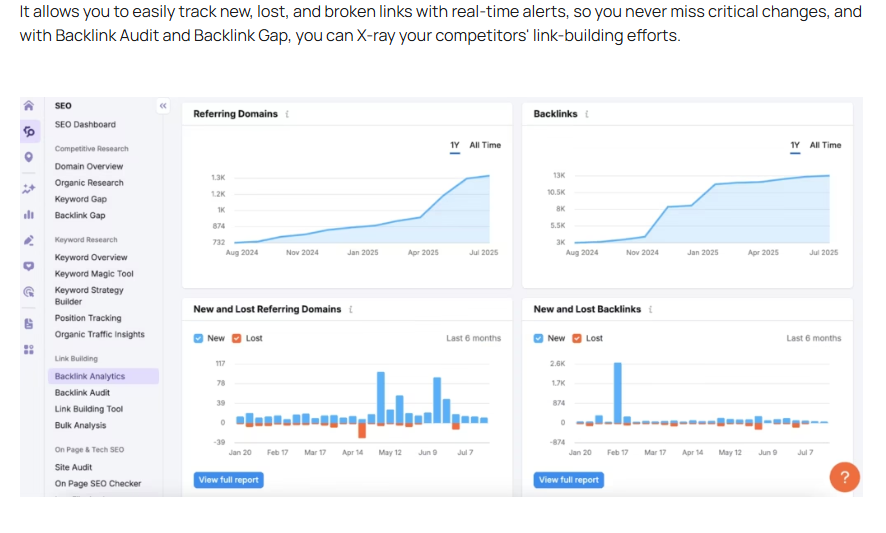
Visuals break up text and make the information easy to process – for readers and AI. They also keep readers on page, increase visibility in visual search, and pages with 7 or more images attract more links and shares, driving SEO performance.
Step 8. Optimize for SEO and readability
Talking of SEO performance, the next step is optimization for organic search engine and LLM visibility.
My SEO optimization checklist includes:
- Using primary keywords (in the title, introduction, headings, metadata, visual file names, and alt texts. Naturally, without keyword stuffing.)
- Including secondary keywords and related phrases — in subheadings and the text to capture variations.
- Adding internal and external links to authoritative sources, product pages, and other relevant content to build topical authority.
I normally use an SEO optimization tool, like Surfer, NeuronWriter, or Clearscope, so a lot of it happens as I’m drafting, and now I just double-check to make sure all boxes are ticked.
As to AI search optimization, here are a few best practices to follow:
- Use a clear H2/H3 hierarchy and dense headings to guide the crawlers (and readers)
- Write in short paragraphs, 2-5 sentences
- Break the text down into semantically complete chunks
- Start sections with the main takeaway, provide details later (BLUF)
- Use bulleted/numbered lists to make the article easy to scan
- Write in conversational style and organize content around customer questions
- Back up claims with sourced data and quotes
- Embed authority signals within the text (for example, as SME bios)
- Create tables and comparison charts in HTML, not in graphic design tools, for easier parsing (AI models are getting better at processing audiovisual media, though)
Most of these things aren’t new — I was doing them way before AIO/GEO/LLMO became a thing.
Step 9. Edit the draft into a publish-ready asset
The final step is editing the piece.
My editing process looks like this:
- Outline/high-level edits (structure and depth consistency across sections, factual accuracy, evidence/logic)
- Line-edits (tighten the copy by removing filler and repetition, replacing cliches with fresher language, varying sentence length)
- Checking the work against past client feedback to avoid the same mistakes
- Proofreading
10 Product listicle best practices
These rules apply regardless of the order you follow them in. Scan the ones that matter most for your current article.
Start with your product or service
The primacy effect, limited scroll depth (most readers never reach the bottom), and LLMs tending to quote content earlier on the page all work in your favor.
Be transparent and honest
Admit bias up front, triple-check facts about competitors, never badmouth them, and weight each section equally. Customers sniff out spin instantly.
Don’t “skyscraper” competitor listicles
Longer lists don’t help readers decide — they expand the decision. Pick the products that best address user needs and go deeper on each.
List products that don’t fit — and explain why
Brief 1–2 sentence explanations for unsuitable products help readers narrow down faster, while still letting you rank for the keywords.
Break down the pricing properly
“Starts from $$$” plus a screenshot isn’t helpful. Break down plans, estimate costs for usage-based pricing, and factor in add-ons for true TCO.
Use recent reviews only
Anything older than a year may not reflect the current product. Check Reddit, Instagram, and Facebook for fresh feedback — or test the feature yourself.
Be skeptical of 5-star only reviews
It’s hard to be perfect. If a product has only 5-star reviews, treat them with caution and cross-check on other platforms.
Don’t use AI for feature or pricing research
LLMs pull from training data and ranking pages that may be outdated or written by competitors. You’ll get inaccurate data. Scrape official product sites instead.
List differentiators, not feature lists
Everyone has transcription. What matters is Descript’s text-based editing or Tella’s autofocus — the features that actually help readers choose.
Include a summary table
A table with key info at the top gives readers a quick overview. AI bots can parse structured data easily, which boosts your chance of getting cited.
1. Start with your product or service
If you want people read about your product or service, put it up front. For 3 reasons:
- The primacy effect. People tend to remember things they see first.
- The scroll depth. While current data is scarce, past studies indicate that readers don’t scroll past the first 30-60% of the page, so there’s a chance the reader never gets to the last item. Having said that, I would expect committed decision-makers to dig deeper than an average reader.
- LLMs tend to quote content that appears earlier on the page. The further down the list, the lower the chances of getting featured. This is likely to change, though, as algos evolve to better match user intent.
2. Be transparent and honest
When comparing products or listing alternatives, be fair, transparent, and honest.
When writing about your product or service, it’s hard to be objective. One reason? You know it better than your competitors, so you can offer more insights. (And yes, you want the reader to pick yours.)
My approach:
- Be as objective as possible, but admit up front that I may not be, to preempt concerns.
- Always double and triple-check if what I write about competing products is true. Not to misrepresent their offerings.
- Never badmouth competitors.
- Weight each listicle section equally so I don’t focus on one product (mine) more than the others.
Lack of honesty and transparency can backfire big time. Customers will sniff it out immediately, and you will lose all credibility.
But let’s imagine they don’t and go on to buy your product — even if it doesn’t satisfy their needs.
That’s even worse!
Your Sales and customer success teams will have potentially wasted a lot of time and energy onboarding a customer who is going to churn.
And think about the reputation damage that their negative feedback might cause!
3. Don’t “skyscraper” competitor listicles
When writing ‘best of’ list posts, don’t try to make yours longer than competitors at all costs.
We’ve all done it: the competing articles list 10 products, so let’s make it 15. They have 20, I’ll do 25. Or 30. The old good Skyscraper method.
And there are SEO incentives: listing more products helps you capture more branded traffic.
Here’s the kicker: such crazy long lists don’t help the reader make a decision. It makes it more difficult because instead of narrowing the list, you expand it for them.
Worse yet, the quality suffers. Covering 50 products in detail is hardly ever an option (especially if you’re limited to 2500-3000 words).
My approach: Choose the products that best address user needs, desires, or pain points, and explore them in more depth. Provide valuable information that enables readers to make informed choices.
4. Do list products that don’t fit the bill and explain why not
When I create a listicle, I also list products that aren’t suitable for the target reader.
And explain why they aren’t a good choice.
The explanations aren’t as detailed as the main entries. Just bullet points with 1-2 sentences, like in the article for Doofinder about ecommerce platforms for small businesses.
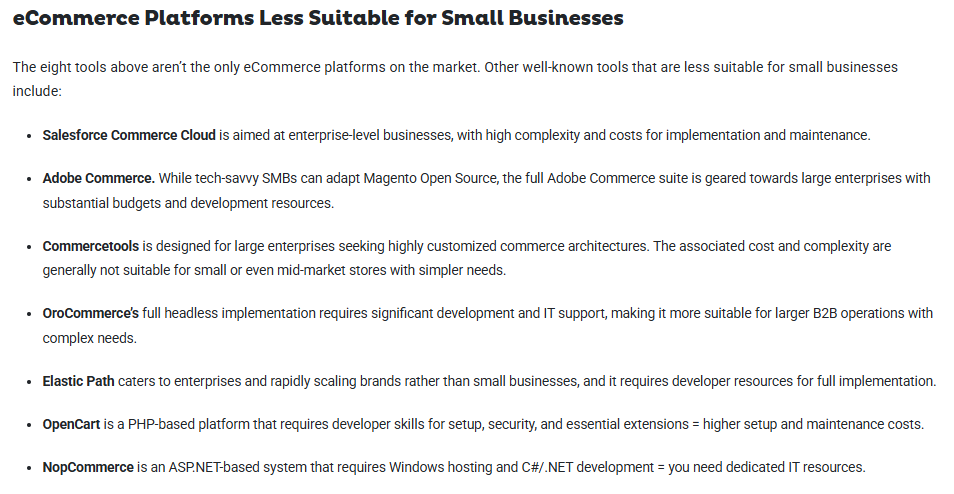
By listing less suitable products or services, I can still rank for the keywords while helping readers to narrow down their options even further.
5. Break down the pricing to reflect the true cost of using the product
“Prices start from $$$” + a lonely pricing page screenshot.
That’s what many pricing sections in listicles look like.
I know. I’ve written a few of these myself. And honestly, if you have 150-200 words to write about a digital product, a deep dive into pricing isn’t an option.
But how helpful is such a section?
Not very. Because it says nothing about what it means to the reader. They might as well visit the product website.
A better approach to writing pricing sections:
- Break down the pricing plans to find the most suitable one based on relevant features. Don’t waste your word allowance on the free plan when you’re writing for enterprise clients.
- For usage-based pricing (data, MAUs, hours, etc.), estimate their needs and tell them how much they’re likely to pay. Now and in the future, as they scale.
- Consider all the add-ons, like templates, themes, and commissions (e.g., credit card fees), to calculate the total cost of ownership (TCO).
6. Use recent reviews
When researching a product, look at recent reviews only.
For software tools, anything older than a year may not be valid. If the company is listening to their customers, they have dealt with the issues by now (if they haven’t, do flag it up in the article).
No recent reviews?
Check Reddit, Instagram, and Facebook for any mentions.
No luck again? Test the specific product aspect if you have access.
7. Be skeptical about 5-star only reviews
If the product or service has 5-star-only reviews, be cautious.
There’s a risk the reviews might not be genuine.
It’s difficult to be perfect.

8. Don’t use AI to research product features or pricing
When researching for listicles, don’t use AI assistants.
LLMs like ChatGPT, Gemini, or Perplexity pull data from various sources. Apart from the original data they were trained on, they also use ranking pages.
These could be on the product website, but they don’t have to be. They could have been written by competitors or not updated for ages.
The result? Inaccurate information about the features or prices. I see it all the time.
It doesn’t mean you can’t automate product research with AI. I’ve built workflows that scrape the product website for detailed information about product features, use cases, pricing, user persona, and technical information.
Focusing the search on the official product website and reducing the reliance of the LLM to extract data from the pages increases reliability and accuracy.
9. List differentiators, not feature lists
When comparing similar products, don’t simply list features. Focus on differentiators, instead.
For example, if you’re writing about video editing software, like Descript or Tella, the transcription feature is the norm. Clients know it and expect it from such a product. Listing it won’t make the choice between the products easier.
Giving them unique features and their benefits will.
Descript is brilliant thanks to its text-based editing and sound and video enhancement, like Eye contact. Tella’s autofocus feature is priceless if you use a lot of visuals in your videos.
10. Include a table summarizing the article
A table summarizing the key information about the listed products, like their features, prices, and overall verdict, at the beginning of the article, gives readers a quick overview of what is what.
And AI bots can easily access information in such structured formats, so it increases the likelihood of getting cited.
Would a bulletted or numbered list work? Sure, but I find them harder to digest.

Create listicles that get cited and drive user action
Listicles have been the cornerstone of every content strategy I’ve seen. Even if LLMs stop prioritizing them in their citations at some point, they will still remain valuable content assets that help you differentiate your product and drive free trial sign-ups or demo bookings.
Creating a listicle that delivers results isn’t as straightforward as it seems. There are factors to consider — unique to each product line and buyer persona. Listing features and pasting a pricing page screenshot hardly ever cuts it.
If you need help creating in-depth listicles that drive visibility and growth, let’s chat!
Listicle FAQs
To wrap it up, here are answers to common questions about list articles.
What is a listicle?
A listicle is an article organized as a list, where each point answers a part of the question.
For example, “7 Best Project Management Tools for Small Teams” or “How to Optimize Your Website for AI in 7 Steps.”
Why are the benefits of listicles for SaaS?
Listicles work well in SaaS content marketing because they:
- Match online reading behavior: People skim rather than read every word. Listicles break information into concise, numbered sections, making it easy to find and digest information.
- Set clear expectations: A headline like “7 Ways to Improve Customer Retention” tells readers exactly what they’ll get, increasing trust and click‑through rates.
- Increase visibility in organic and AI search results: Structured lists are easier to process for AI bots, especially when backed up with schema markup, which can get it featured in rich results. And they target branded keywords with commercial intent.
- Move prospects towards purchase: “Alternatives” posts and product‑comparison listicles help readers compare options and understand why your tool is superior. They attract readers who already know they need a solution and are ready to decide.
What are the different listicle formats in SaaS content marketing?
Common types of listicles in content marketing are:
- Alternatives posts: Present several alternatives to a competitor product (e.g., “Top 10 Salesforce Alternatives”).
- “Best of” or “Top tools” posts: Just like alternatives posts, they list products in a category (e.g., “10 Best Customer Success Tools”)
- Comparison listicles: They compare two or three similar products in more depth (Asana vs Trello vs Paymo)
- How-to/Use case guides: Show readers how to solve a problem using your product (“8 Steps to Automate Invoicing”)
- Case‑study listicles: Highlight multiple customer success stories (“5 Companies That Cut Churn With Userpilot”)
What are the key differences between BOFU and general listicles?
The three main differences between BOFU and general listicles revolve around:
- Audience intent: BOFU readers are evaluating solutions and are close to making a purchase. They want in‑depth information, comparisons, and evidence, not just general tips.
- Content focus: BOFU listicles focus on the product — its features, pricing, use cases, and customer proof — and linking them to reader pain points.
- Keyword strategy: High‑intent, solution‑aware, and competitor‑comparison keywords (e.g., “best CRM software,” “HubSpot alternatives,” “[product] pricing”) are more important than search volume. Fewer readers may click on them, but they’re more likely to convert.
