
When you have one freelance client, you don’t need project management. You just do the work.
But somewhere between client two and client four, things start slipping. A missed deadline here, scattered files there, that 2 AM panic about whether you confirmed a due date. Which gets in the way of delivering quality work.
In the last four years as a freelance writer, I’ve been able to avoid major crises when juggling multiple client relationships thanks to the project management skills I developed in my previous life.
These are the skills that made the difference.
Key takeaways
- Freelance project management is less about Gantt charts and more about managing your own capacity, communication, and systems.
- Scope every project before you start — define deliverables, timelines, and what’s out of scope. This prevents scope creep and sets expectations.
- Context-switching between clients is the real productivity killer, not the volume of work. Batch similar tasks and protect deep focus time.
- Client communication is a key PM skill. Setting expectations upfront saves you from firefighting later.
- Track your time to understand your actual capacity — not just for billing, but for knowing when to say no.
- Protect time for business operations (invoicing, marketing, prospecting). If it’s not scheduled, it doesn’t happen.
Scope every project before you start
The single most impactful project management skill for freelancers is defining what you will and won’t do before the work begins. Scope creep is the number one reason freelance projects go sideways — and it’s almost always preventable.
A scope statement doesn’t have to be formal. For every new project, I define three things: the deliverable (what I’m producing), the timeline (when it’s due), and the boundaries (what’s not included).
Here’s what that looks like in practice. For a content writing project, my scope might read: “I’ll deliver a 2,000-word blog post with two rounds of revisions within 10 business days. Additional revisions are billed at my hourly rate.” That takes 30 seconds to write and saves hours of back-and-forth later.
When a client wants changes, I use a simple framework: scope, quality, and time. If they want the same quality faster, I will reduce the scope. If they want the same scope faster, quality may suffer. I hold firm on quality — scope and time are the variables I’m willing to adjust.
And put scope in writing. Contracts, proposals, or even a brief email confirming the agreement. Helps avoid misunderstandings that can ruin the relationship and cause tons of unnecessary stress.
Manage your capacity, not just your time
Most freelancers track deadlines, but not bandwidth. Time management tells you what to do today. Capacity planning tells you what you can take on this month — and when to say no.
Track your time to find your real numbers
Track everything — billable and non-billable hours. This is the single most valuable project management habit I’ve built.
After a few weeks of tracking, you’ll know how long deliverables actually take, not how long you think they take. That kills the guesswork around pricing and scheduling. A blog post you quote as “5 hours” might consistently take 7 once you include research, outlines, and revisions.
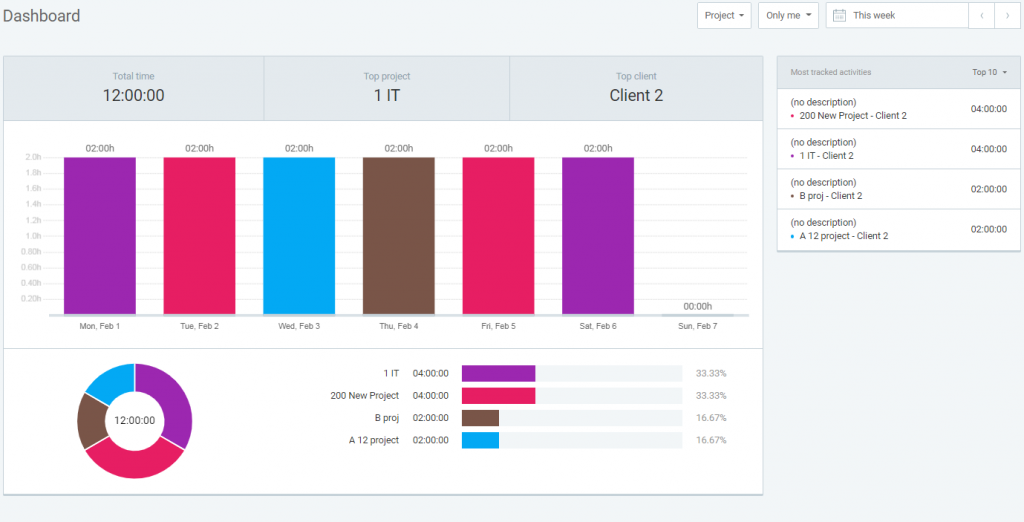
Time tracking also reveals how much of your week goes to admin, email, and meetings — the invisible work that eats your capacity without showing up on any invoice.
Know when to say no
Most freelancers don’t turn down work until they’re already drowning. By then, quality has already slipped on everything.
Set a weekly hour cap for client work. I know freelancers who cap at 20 hours per week — the rest goes to business operations and buffer time for when things run long.
When a new project would push you past your cap, you have three options: decline, negotiate a later start date, or wrap an existing project first.
Saying no to one project protects the quality of everything else on your plate. It feels uncomfortable the first few times. But the alternative — delivering mediocre work to five clients instead of great work to three — is worse for your business long-term.
Build a system that survives context-switching
The hardest part of freelance project management isn’t the workload — it’s the mental load. Switching between completely separate clients, teams, and communication styles is exhausting, even when the total hours are manageable.
Having two clients at 10 hours each feels harder than one client at 25 hours. There are multiple entirely separate teams of people to keep happy, different expectations to track, and constant context-switching — even if it’s only one switch per day.
Your system needs to handle this.
Keep a “state of play” for each client
Before you close out work on Client A and open Client B, you need a fast way to pick up where you left off.
I keep a running “state of play” note for each client with three things: what’s in progress, what’s due next, and any open questions or blockers. I update it at the end of every work session. It takes about two minutes. But it saves 20 minutes of context recovery the next time I switch back to that client.
The tool doesn’t matter. Notion, a text file, a physical notebook — whatever you’ll actually update. The habit matters more than the software.
Batch similar work and protect focus time
Dedicating full days or half-days to a single client reduces context-switching and lets you do deep work. When I can spend a full morning on one client’s content instead of bouncing between three inboxes, the output is better and the day feels less chaotic.
If single-client days aren’t possible, batch similar tasks instead. All writing in the morning, all admin and emails in the afternoon. Block your calendar for focus time — clients will fill every gap you leave open.
The freelancers who manage 3-4 clients without burning out aren’t working more hours. They’re switching contexts less often.
Communicate like a project manager
Most freelancers communicate like task-takers: “Done, here it is.” Project managers communicate proactively — they set expectations, flag risks early, and manage scope changes before they become problems.
- Set expectations on day one. Agree on communication channels, response times, and feedback turnaround. “I check email twice a day and respond within 24-48 hours” is a boundary that prevents the expectation of instant availability.
- Flag delays early. If you’re going to miss a deadline, say so as soon as you know — not the day it’s due. Clients can handle a heads-up. They can’t handle a surprise.
- Push back on scope creep directly. When a client asks for something outside the original agreement, name it: “That’s outside the original scope. I’m happy to do it — here’s what it would cost and how it affects the timeline.” Most clients respect this.
- Send unprompted updates. A brief weekly status message — “Here’s where things stand, here’s what’s next” — builds trust and reduces the client’s urge to check in constantly. It takes five minutes and positions you as someone who’s managing the project, not just executing tasks.
Don’t confuse being responsive with being available. Responsiveness is about reliability and follow-through, not reply speed. Communication is one of several critical freelance skills that separate reliable freelancers from everyone else.
Protect time for the work nobody pays you for
Client work will always feel more urgent than invoicing, updating your portfolio, or prospecting for new clients. But if you don’t schedule time for business operations, your business stops growing — and you end up in a feast-or-famine cycle.
Think of your entire freelance business as one project that runs in parallel with all your client projects. It needs its own recurring tasks: send invoices, follow up on payments, update your website, respond to leads, review your pipeline.
I schedule a fixed weekly block for business admin. Friday afternoons work well — client requests typically slow down, and I can close out the week with a clear picture of where things stand financially and operationally.
Working on your business is equally important as working for your clients. If you’re starting out as a freelance writer, building this habit early saves you from the boom-and-bust cycle that burns people out in their first year.
Keep your PM system simple
Freelancers don’t need Jira, Monday, or any enterprise-grade project management tool. What you need is a system you’ll actually use — and that usually means something simple.
The minimum viable PM system for a freelancer has four components:
- A task list with due dates and client labels — Notion, Trello, Asana, or even a spreadsheet
- A calendar with deadlines and focus blocks
- A time tracker — Toggl, Clockify, or built-in features in tools like Bonsai
- A file system with a consistent folder structure per client
That’s it. You can add complexity later, but start here.
The biggest PM mistake freelancers make is spending more time configuring their system than doing the work. If you’ve tried three PM tools in the past month, the problem isn’t the tool — it’s the lack of a simple process underneath it.
Review your system weekly. A 15-minute Friday review of all active projects, upcoming deadlines, and open items catches problems before they escalate.
Final thoughts
Freelance project management isn’t a separate discipline you need to study. It’s a handful of habits: scope your work, track your time, communicate proactively, protect your capacity, and keep things simple.
The freelancers who scale without burning out aren’t the ones with the fanciest tools. They’re the ones who treat their freelance business like a project worth managing.
If you’re looking for a freelance writer who delivers on time and manages the process so you don’t have to — get in touch.
FAQ
What is the best project management tool for freelancers?
The best project management tool for freelancers is one you’ll actually use consistently. Notion, Trello, and Asana all work well for solo freelancers and have free tiers. The key is a simple setup: task lists with due dates, a calendar view, and a consistent file structure. A spreadsheet you use daily beats a fully configured PM platform you abandon after a week.
How many clients can a freelancer manage at once?
Most freelancers find that 3-5 active clients is the sweet spot. Beyond that, context-switching costs increase, and quality starts to drop. The actual number depends on project complexity, your working hours, and whether the work is retainer-based or project-based. Track your time for a few weeks to find your real capacity before taking on more.
How do freelancers handle scope creep?
Freelancers handle scope creep by defining the scope in writing before starting any project — deliverables, timelines, revision limits, and what’s excluded.
When a client requests something outside the agreement, name it directly: “That’s outside the original scope. Here’s what it would cost.” Putting boundaries in your contract makes this conversation easier because you’re referencing an agreement, not starting a negotiation.
Do freelancers need formal project management training?
Freelancers don’t need formal project management training like PMP certification, which is designed for managing teams, budgets, and organizational resources. Freelancers need a different subset of PM skills: scoping, time tracking, capacity planning, and client communication.
These are best learned through practice, not coursework. Start with one habit — like tracking your time — and build from there.
How do I stop feeling overwhelmed with multiple freelance projects?
The overwhelm usually comes from context-switching and information scatter, not from the volume of work itself. Two fixes help immediately: keep a running “state of play” note for each client so you can pick up where you left off, and batch your work so you’re not jumping between clients multiple times per day.
