AirOps does something useful: it lets SEO teams build automated content pipelines that connect AI models to data sources, run multi-step workflows, and produce content at scale without developer resources. The visual workflow builder, pre-built agents, and AI visibility tracking solve real problems for teams that produce content in volume.
But the platform’s flexibility comes with trade-offs. The workflow builder has a steep learning curve (the most common complaint on G2, with 33 mentions), onboarding the rest of your team is harder still, and task-based pricing can make costs unpredictable at scale. For teams that don’t need custom AI workflows — or don’t have the bandwidth to build and maintain them — a more focused tool often delivers faster results.
This article covers eight alternatives that SEO and AI content teams are switching to, what each one does well and where it falls short, how to match the right tool to your content goals, and when a human writer still beats any AI platform.
Compare the Alternatives
AirOps Alternatives Compared
Filter by what you need the tool to do. “AI search tracking” shows whether it monitors your visibility in ChatGPT, Perplexity, Google AI Overviews, and other AI engines.
| Tool | Best For | Starting Price | AI Search Tracking | Standout Feature |
|---|---|---|---|---|
| Surfer SEO | On-page optimization | $99/mo | ✓ 5 platforms | Unified SEO + AI Search Content Score |
| Clearscope | Content grading | $129/mo | ✓ 3 platforms | 9.6/10 ease of use; NLP term recommendations |
| Frase | Research & briefs | $39/mo | ✓ 5–8 platforms | Agentic AI with dual SEO + GEO scoring |
| MarketMuse | Content strategy | Custom | — | Patented topic modeling with personalized metrics |
| Jasper AI | Brand voice at scale | $59/seat/mo | ✓ GEO Agent | 100+ marketing agents with centralized brand IQ |
| Writer | Enterprise compliance | $29/user/mo | — | Proprietary Palmyra LLMs, HIPAA/SOC 2, zero data retention |
| Writesonic | GEO & AI search | $79/mo | ✓ 10 platforms | Action Center converts visibility gaps into fixes |
| Copy.ai | GTM workflow automation | $24/mo | — | Multi-step GTM automation across sales & marketing |
No tools match that filter.
Pricing and features as of October 2026, from vendor pricing & product pages. Verify current pricing before purchase.

What AirOps does and why SEO teams use it
AirOps is an AI-powered content automation platform built around a visual workflow builder. Teams connect AI models from OpenAI and Anthropic to data sources like Google Search Console, BigQuery, and Google Sheets, then chain those connections into multi-step pipelines that run with a single click.
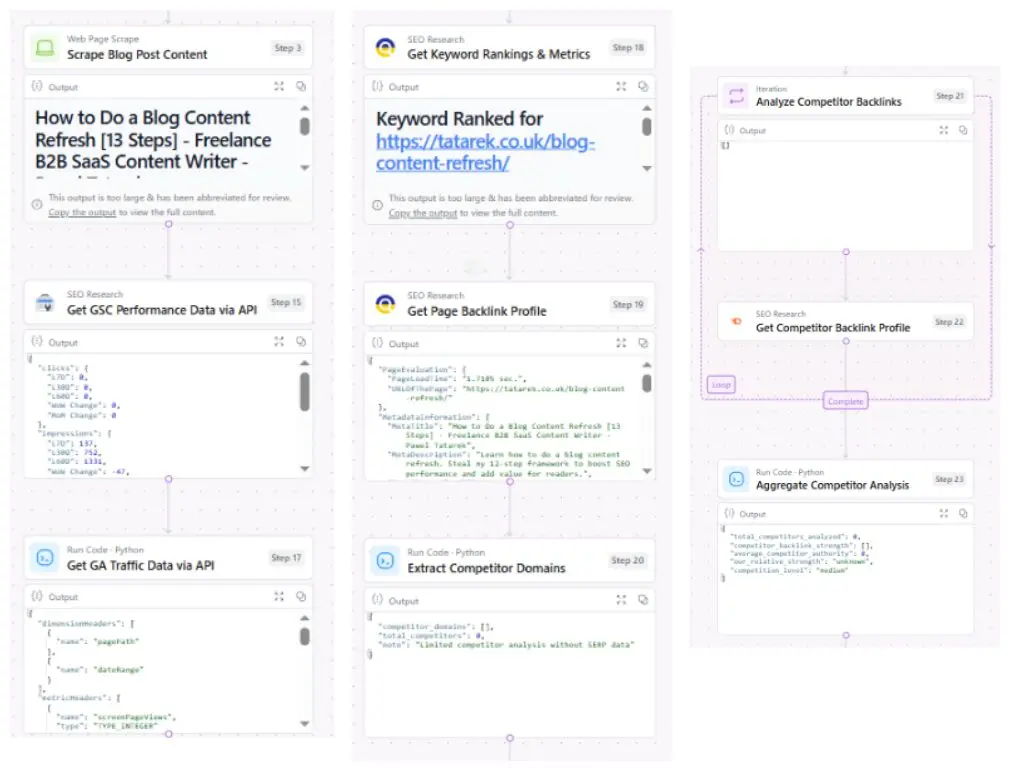
A typical AirOps workflow pulls search performance data via API, runs it through LLM-powered clustering and analysis, generates content briefs based on keyword gaps, and produces optimized drafts — all in one automated sequence.
The platform also tracks AI visibility and brand mentions across multiple search engines, which gives teams data on how their content performs in AI answers alongside traditional SERPs.
AirOps offers both pre-built power agents for common tasks and a custom workflow builder for teams that want to design their own systems. Brand knowledge features let teams upload tone guidelines and key messaging so AI content stays on-brand. For high-volume operations, the platform supports programmatic content generation at scale and can produce hundreds of pages from structured data.
SEO teams use AirOps because it combines AI models, data sources, and publishing tools into a single automated pipeline. Less time on repetitive content production, more time on strategy and producing high-quality content.
Five reasons why teams look for AirOps alternatives
While AirOps is a mighty tool, it isn’t always a good fit for all teams.
Here are the top five reasons why you might be considering an alternative solution.
Complex workflow building slows down content production
AirOps requires a technical mindset to set up properly. Building custom workflows involves connecting multiple nodes, configuring prompts, and troubleshooting when things break. The steep learning curve is the most common complaint on G2, with 33 separate mentions.
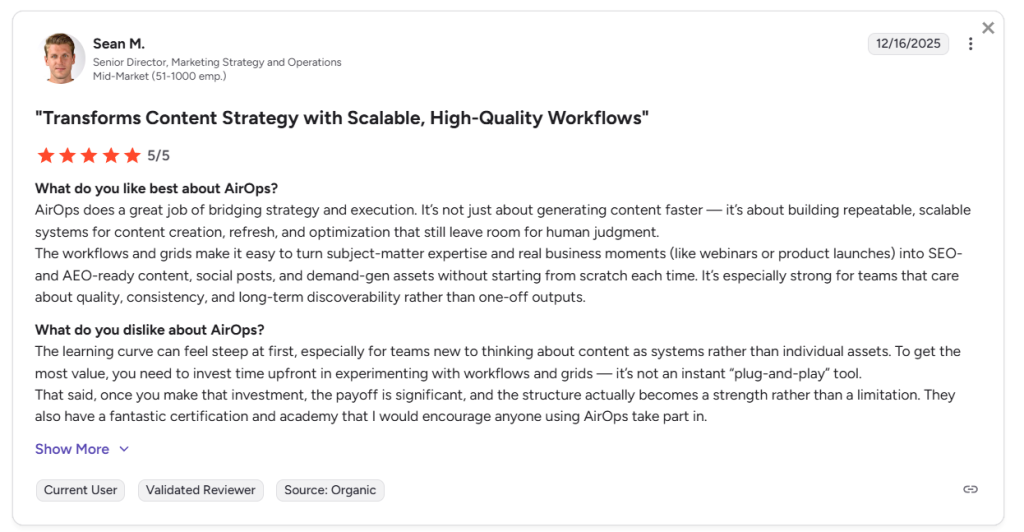
One Senior Director of Marketing Strategy and Operations wrote: “The learning curve can feel steep at first, especially for teams new to thinking about content as systems rather than individual assets. To get the most value, you need to invest time upfront in experimenting with workflows and grids — it’s not an instant ‘plug-and-play’ tool.”
Others are blunter. A Martech Manager at a mid-market company wrote: “The workflow builder is so unusable and it is taking me hours to figure out something simple. I just need to configure 3 steps in a workflow and it took me a day to figure things out.”
AirOps offers certification cohorts and live training sessions to close this gap, but this takes time. As the reviewer points out, the investment pays off. But it may not work if your team is at capacity and you want to start producing content from day one.
Want to use AirOps to scale content production but have no time or bandwidth to learn the tool and customize the workflows? Hiring an AirOps-trained content engineer — like myself — solves the problem.
Pawel Tatarek · Freelance B2B SaaS Content Writer
AI content quality often requires significant human editing
The content AirOps generates follows the same pattern as most AI tools: serviceable but generic. For SEO teams focused on E-E-A-T signals and ranking for competitive terms, generic doesn’t cut it.
An AEO/SEO Editorial Strategist at an enterprise company gave AirOps 5 stars but was candid about this trade-off: “Output accuracy is still the thing we watch most closely. We’ve caught incorrect stats, wrong product details, and facts that just needed a second look before publishing. It means editing time is still real.”
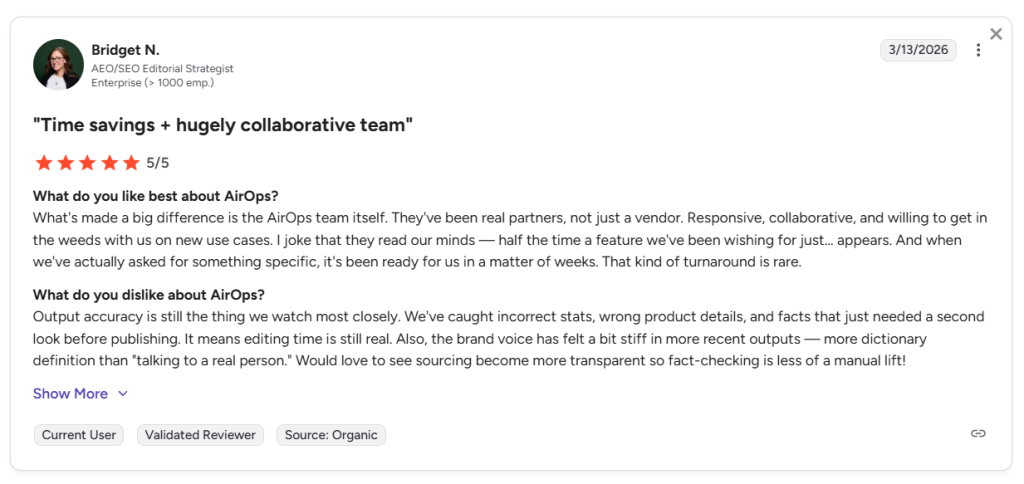
The same reviewer flagged brand voice as a separate issue: “The brand voice has felt a bit stiff in more recent outputs — more dictionary definition than ‘talking to a real person.'”
Other reviewers echo the accuracy concern. A Verified User in IT and Services wrote: “LLMs are prone to hallucinations, meaning you’ll need to continuously review and validate outputs. Some workflows are buggy, requiring multiple runthroughs and eating resources.”
I found similar issues with the content generated from the off-the-shelf templates. I was able to alleviate some of them in my custom-built workflows, and the output requires far less editing. But I would still never publish it without a thorough human review.
Bear in mind, though, you may have the same problem with other tools.
Pricing and hidden task consumption costs add up quickly
Pricing-related complaints appear in 21 separate G2 reviews. The nature of the concerns is two-fold.
First, AirOps is generally considered pricey.
A Senior Content Marketing Manager wrote: “AirOps is pricey. If you have the budget, it’s totally worth the investment, but I know that most smaller teams might not be able to afford it.”
There’s no free plan anymore; the Solo plan is $200/month, and the Pro one is $2000/month.
The other concerns are related to the task-based pricing.
The Solo and Pro plans come with 20k and 75k tasks, respectively. In the Enterprise plan, the task allowance is custom. If you use their template, the 20k is enough to create 7-8 articles of around 2k words.
If you use the templates or power agents, the task usage is easy to estimate, but not so with custom workflows.
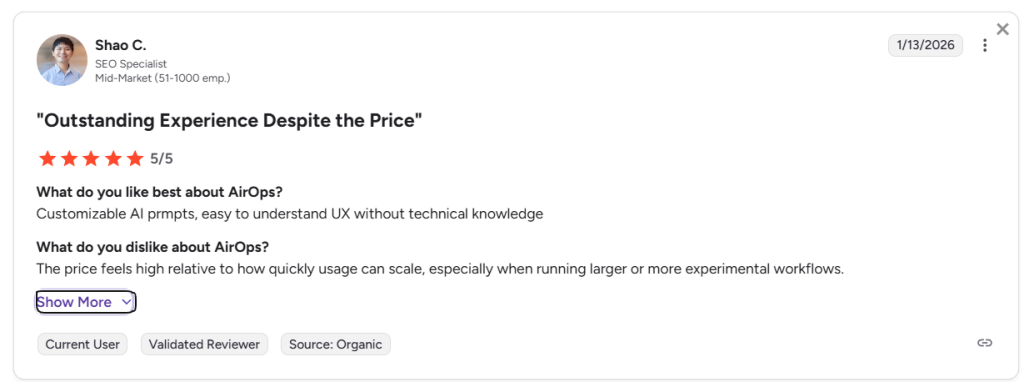
An SEO Specialist wrote: “The price feels high relative to how quickly usage can scale, especially when running larger or more experimental workflows.”
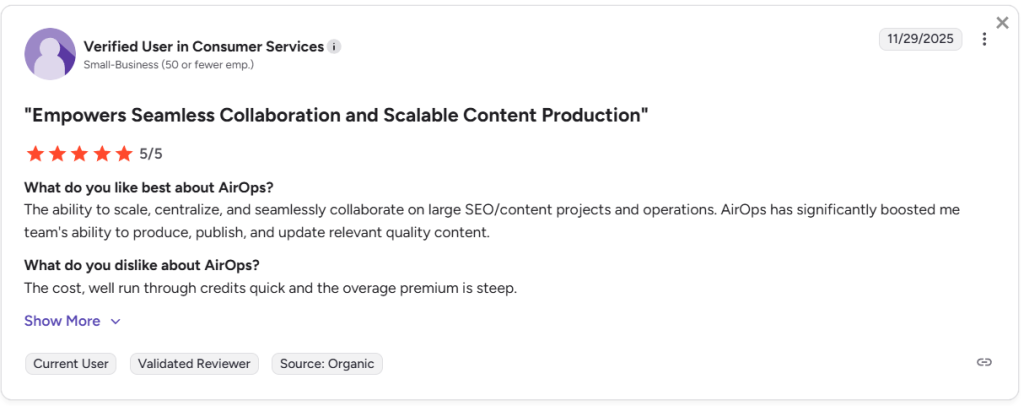
And once you run out of tasks, you pay extra for all additional ones. One user put it plainly: “Run through credits quick and the overage premium is steep.”
Credit-based pricing is common in AI-powered SaaS tools, but if you have a restricted budget, this may not work for you.
What to look for in an AirOps alternative
When choosing the AirOps alternatives for your team, consider these factors.
- SEO optimization and SERP analysis features: The best alternatives include built-in SEO capabilities rather than treating optimization as an afterthought. Real-time content grading matters here — you want feedback while writing, not after publishing.
- Content quality and brand voice consistency: Content that sounds robotic doesn’t inspire trust and can damage your brand. Prioritize tools that let you train custom voice profiles and set style guidelines.
- GEO and AI search visibility capabilities: Generative Engine Optimization (GEO) refers to optimizing content so it appears in AI-generated search results from search engines like ChatGPT, Perplexity, and Google’s AI Overviews. The best alternatives now track whether your content gets AI citations in these answers, not just whether it ranks in traditional SEO results.
- Integrations with your existing SEO stack: Check whether the tool connects to your CMS, Google Search Console, and analytics platforms. Smooth integrations reduce friction.
- Transparent pricing and scalability: Compare usage caps. Calculate the total cost at your expected content volume, including any add-ons for premium features.
The best AirOps alternatives for SEO content teams
Here are the seven best AirOps alternatives for content and SEO teams.
Surfer SEO for on-page optimization and AI search visibility
Surfer SEO analyzes top-ranking pages and provides real-time recommendations as you write. Its Content Score metric updates with each change and shows keyword density, heading structure, NLP terms, and word count targets — all derived from 500+ ranking signals. Surfer reports a 0.28 Spearman correlation between Content Score and Google rankings, based on its own study of 1M SERP entries (worth treating as the vendor’s internal research, not an independent finding).
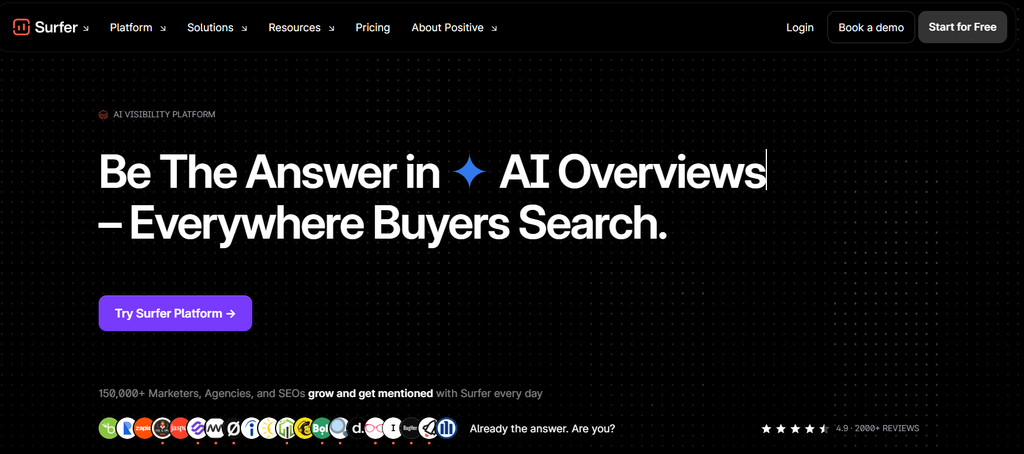
Beyond the content editor, Surfer — now operating as Positive Surfer following its acquisition by Positive, and repositioning around AI visibility — has moved aggressively into AI search optimization. For example, the Content Score is unified: a single bar shows SEO and AI Search optimization side by side, and Auto-Optimize now applies both SERP-driven improvements and AI-citation fixes (missing entities and facts) in one click.
The AI Tracker monitors brand visibility across ChatGPT, Perplexity, Google AI Mode, Google AI Overviews, and Gemini. Auto Internal Links uses GSC data for semantic-based linking suggestions, and the Topical Map identifies content gaps and keyword clusters. A Humanizer, plagiarism checker, and the in-editor “Surfy” assistant are now standard parts of the Content Editor.
- Pricing: Standard $99/mo ($119 monthly), Pro $182/mo ($219 monthly), Peace of Mind $299/mo ($359 monthly). Two narrower tiers now sit alongside these: Discovery ($49/mo, content only, no AI tracking) and AI Search Analytics ($82/mo, AI visibility tracking only). Annual billing saves up to 23%. No free trial — only a 7-day money-back guarantee. Surfer AI article credits cost extra.
- Ratings: G2 4.8/5, Capterra 4.9/5.
- What to watch for: Surfer isn’t a full SEO suite. It lacks backlink analysis, PPC monitoring, and advanced keyword research — most users pair it with Ahrefs or Semrush. Pricing is the most frequent criticism across review platforms. The Content Score methodology has skeptics who call it over-reliant on correlations, and YouTube reviewers warn against chasing a perfect score: “Just because you get a 100 with the content score doesn’t mean you get a 100 in Google.”
- Best for: SEO teams that want real-time on-page optimization and AI search visibility tracking, and are comfortable pairing Surfer with a dedicated keyword research tool.
Clearscope for content grading and AI search discoverability
Clearscope grades your content against competitors using NLP-powered term recommendations backed by IBM Watson, Google Cloud NLP, and OpenAI. Where Surfer emphasizes content scoring metrics, Clearscope focuses on editorial quality and search intent alignment.
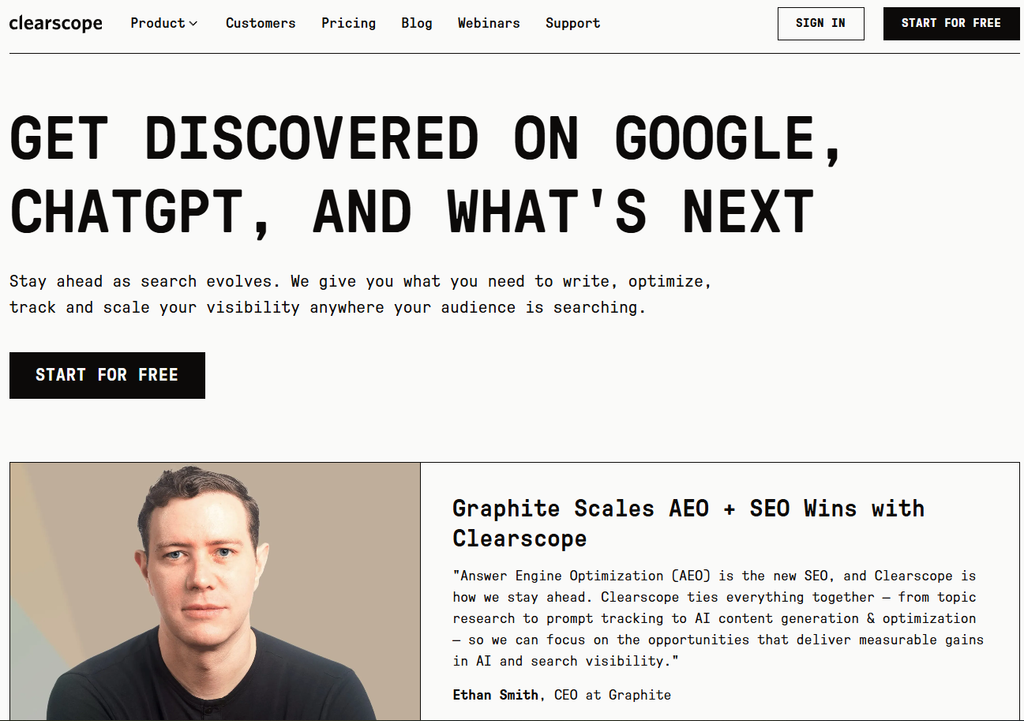
The platform went through a major reinvention in October 2025 (Clearscope 2.0), which repositioned it from a content optimization tool to a “Discoverability Platform.” In July 2026 it added Query Tracking, which extends brand-visibility monitoring to ChatGPT, Gemini, and Claude at the prompt level, with competitor benchmarking and trend graphs. An AI Cited Pages view surfaces which of your pages are already being cited in AI answers, and a one-click Boost Content Grade feature inserts unused recommended terms. The Content Inventory feature provides automated alerts for 404s, indexing issues, and content decay — a safety net for teams that manage large content libraries. Integrations with Google Docs, WordPress, and Microsoft Word keep the tool embedded in existing editorial workflows.
- Pricing: Essentials $129/mo, Business $399/mo, Enterprise custom. All plans include unlimited users and all features. Add-on pages cost $15-25/mo; additional drafts $20-50 per batch. (Query Tracking is priced separately, from $0.65/query.)
- Ratings: G2 4.9/5, Capterra 4.9/5.
- What to watch for: Premium pricing is Clearscope’s most cited weakness. At $129/mo minimum, it prices out freelancers and small teams. The credit-based system frustrates high-volume teams, and some reviewers note the grading system can be inflated through keyword stuffing. Like Surfer, Clearscope doesn’t cover backlinks, technical SEO, or rank tracking.
- Best for: Editorial teams that prioritize ease of use and content quality over technical complexity. The 9.6/10 ease-of-use rating makes it a natural fit for teams leaving AirOps because of its steep learning curve.
Frase for research-driven content creation and GEO optimization
Frase relaunched as an agentic SEO and AI content creation platform in February 2026 (an earlier “Frase 2.0” in late 2024 was a simplification, not the agentic rebuild). Its AI Agent handles research, writing, optimization, and publishing through a natural language interface, which consolidates what would otherwise require multiple tools.
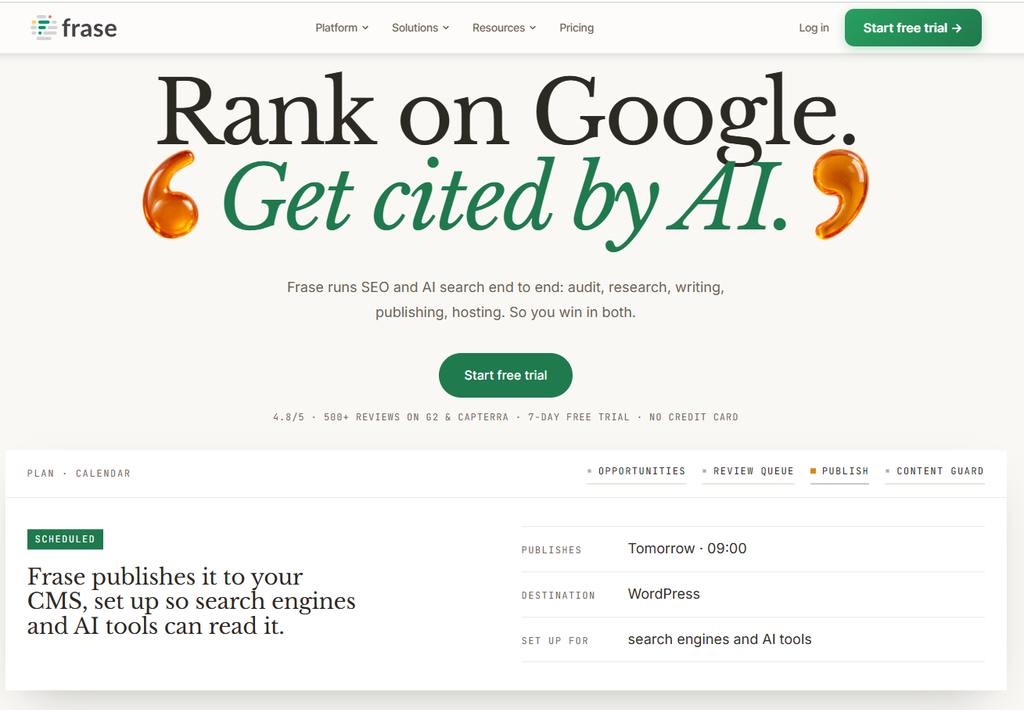
SERP analysis and content brief generation are Frase’s core strengths. The platform analyzes competitor content in about 30 seconds and extracts headings, topics, and questions to build comprehensive briefs. Dual SEO + GEO scoring — launched August 2025 — optimizes content for both traditional search and AI answers simultaneously.
AI Search Tracking monitors brand visibility across five platforms on standard plans (ChatGPT, Perplexity, Claude, Gemini, and Google AI), scaling to eight at the Enterprise tier (adding Copilot, Grok, and DeepSeek). Newer additions include Content Guard (automated decay detection that drafts and republishes fixes on approval), Frase Answers (an on-site AI widget that answers visitors from your own content and captures unanswered questions), FraseCMS, and a first-party MCP server and API for agent-driven workflows. For high-volume operations, programmatic SEO batch-generates page families from structured data.
- Pricing: Starter $39/mo (annual, $49 monthly), Professional $103/mo (annual, $129 monthly), Scale $239/mo (annual, $299 monthly). Additional seats cost $29/mo each. 7-day free trial, no credit card required.
- Ratings: G2 4.8/5, Capterra 4.8/5.
- What to watch for: AI writing quality is mediocre — reviewers describe it as “typical GPT-3.5 writing, boring, repetitive, and lengthy.” Independent testing showed a Frase AI article ranked for 5 keywords vs. 17 for a manually written article. The base price can be misleading: add-ons and per-article fees ($3.50 for Rank-Ready articles) inflate the advertised cost. One reviewer reported paying $75/month after add-ons on what was advertised as a $49/mo plan.
- Best for: Content teams that want an affordable all-in-one platform for research, optimization, and AI search tracking. Of all the alternatives on this list, Frase offers the broadest feature set relative to its price — which makes it the closest comparison to AirOps for teams that want similar automation without the custom workflow complexity.
MarketMuse for content strategy and topic authority
MarketMuse operates at the site and cluster level rather than the individual article level. Its patented topic model analyzes hundreds to thousands of pages — far more than the top 10-30 SERP results most competitors examine — and builds content-inventory views that show where your coverage is strong, where gaps exist, and where you have a competitive advantage.
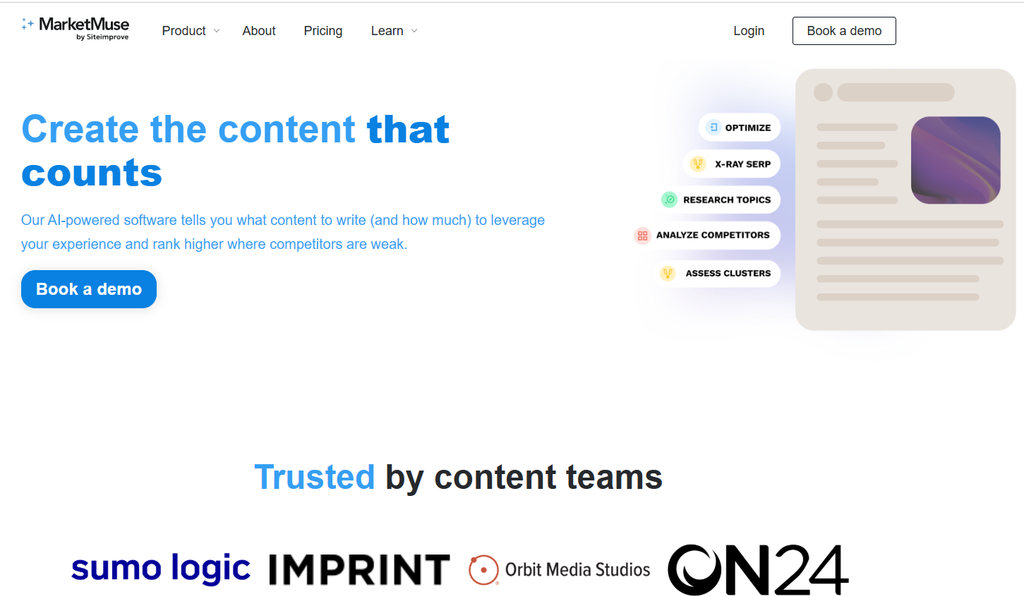
The personalized metrics are what set it apart. Personalized Difficulty scores how hard it is for your specific site to rank for a topic, not a generic difficulty score. Topic Authority measures your site’s coverage breadth and performance across a subject area. Competitive Advantage shows the gap between generic difficulty and your personalized score. No other tool on this list offers metrics that account for your site’s existing authority this way.
Siteimprove acquired MarketMuse in October 2024, and the product continues as a standalone offering (“MarketMuse by Siteimprove”); Siteimprove launched an SEO Intelligence Suite built around MarketMuse’s content-planning technology in May 2025.
- Pricing: Quote-based. MarketMuse no longer publishes self-serve plan prices on its site — pricing is gated behind a sales conversation, with Free, Optimize, Research, and Strategy tiers differentiated by feature. Access to all nine content brief types sits on the top tier.
- Ratings: G2 4.6/5, Capterra 4.6/5.
- What to watch for: Pricing is now opaque — you’ll need a sales call to get a number, which slows evaluation for smaller teams. The learning curve is steep even after extended use: one Capterra reviewer wrote, “I’ve been using MarketMuse for over a year and I still don’t really understand how some things are supposed to work.” Topic suggestions can miss context — one user writing about the FOX TV channel received keyword recommendations about actual foxes.
- Best for: Mid-market and enterprise content teams that manage large sites and need strategic content planning at the site level. If your challenge is deciding what to write and where to invest — not just how to optimize individual articles — MarketMuse fills a gap the other tools don’t address.
Jasper AI for brand voice consistency and marketing content at scale
Jasper AI serves 100,000+ customers, including nearly 20% of the Fortune 500, and has repositioned from an AI writing tool to a multi-agent marketing platform. Its 100+ specialized AI agents handle tasks across the content pipeline — from SEO/AEO/GEO rewriting to ad campaign generation to content personalization. In June 2026, it launched a dedicated GEO Agent for AI-search visibility, and Content Pipelines connect strategy to execution in structured, repeatable workflows.
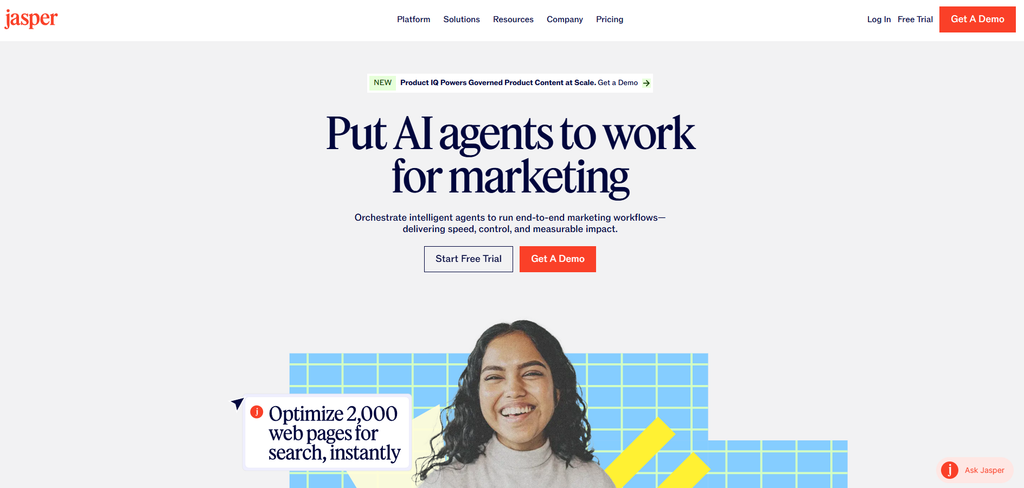
Jasper IQ is the platform’s intelligence layer. It embeds brand voice, visual guidelines, style guides, audience profiles, and a knowledge base into every AI output — now organized across Brand IQ, Marketing IQ, Product IQ, Knowledge, and Governance. That centralized brand control is what users cite most often as the reason to choose Jasper over general-purpose AI tools. For SEO data, Jasper’s Optimization Agent now draws on a Semrush integration.
- Pricing: Pro $59/seat/mo (annual, $69 monthly), up to 5 users. Business is custom with a minimum 12-month commitment. Pro includes 2 Brand Voices and 5 Knowledge assets; Business unlocks unlimited customization, Jasper Studio, Jasper Grid (bulk execution), and API access. 7-day free trial.
- Ratings: G2 4.7/5, Capterra 4.8/5.
- What to watch for: Jasper doesn’t develop its own AI models — it remains LLM-agnostic, orchestrating third-party models from providers like OpenAI and Anthropic, which means the underlying generation quality is similar to what you’d get from those models directly. Content can feel generic for long-form pieces. Pricing is the most consistent complaint: per-seat costs add up fast for larger teams. Users have reported steep price increases when the pricing model changed, and pausing your subscription cuts access immediately — even with paid time remaining.
- Best for: Marketing teams that need brand-consistent content across multiple channels and formats at scale. Jasper’s multi-agent setup approximates what some AirOps workflows do — automated, on-brand content production — without requiring custom workflow building.
Writer for enterprise compliance in regulated industries
Writer is a $1.9B enterprise AI platform (per its November 2024 Series C) that develops its own proprietary Palmyra LLM family — including Palmyra Fin (first to pass the CFA Level III exam) for financial services and Palmyra Med for healthcare. Its Knowledge Graph uses a graph-based RAG system that claims 67% lower cost than vector-based RAG with fewer hallucinations.
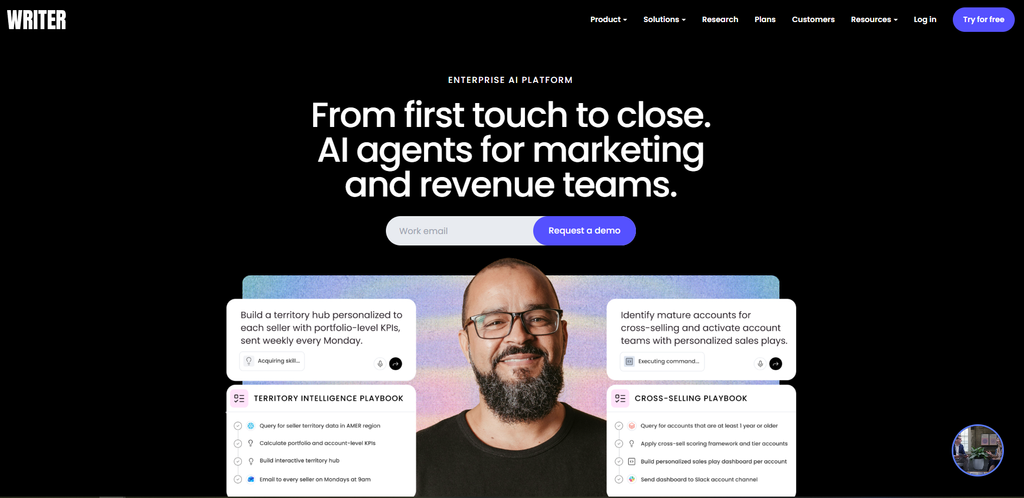
The platform’s primary value is security and compliance. Writer holds HIPAA, SOC 2 Type II, PCI, and ISO 27001/27701/42001 certifications, with a zero data retention policy. AI Studio provides agent-building across three paths — a no-code builder, a new low-code Agent Builder (in beta), and full API/SDK access — with enterprise-grade controls built in: style guides, voice profiles, and terminology management enforce brand standards automatically.
Free Lite seats, launched in March 2026, let wider teams run existing playbooks without needing full access. In August 2026 Writer released Palmyra X6, an agentic flagship model it markets as matching or beating frontier models (Claude Opus 4.8, GPT-5.5, Gemini 3.1) on its own production-task evaluations at a fraction of the cost.
- Pricing: Starter $29/user/mo (annual, $39 monthly), up to 20 users. Enterprise is custom and includes unlimited free Lite seats. 14-day free trial. API pricing is usage-based (Palmyra X5: $0.60/1M input tokens, $6.00/1M output tokens; Palmyra X6: $2/1M input, $8/1M output). 20% non-profit discount available.
- Ratings: G2 4.4/5, Capterra 4.5/5.
- What to watch for: The centralized controls that IT teams value can block business users from self-serving their own workflows. Writer is purpose-built for large enterprises in regulated industries — for a typical SEO content team, the enterprise features are overkill.
- Best for: Large organizations in regulated industries (financial services, healthcare) that require HIPAA compliance, zero data retention, and centralized brand standards. Not a natural fit for most SEO content teams, but relevant for enterprise SEO operations within these sectors.
Writesonic for GEO and AI search visibility tracking
Writesonic started as an AI writing tool and has since pivoted to an AI search visibility platform — it now bills itself as “The AI Search Growth Engine.” Its core proposition centers on tracking and improving brand visibility across 10 AI platforms — including ChatGPT, Claude, Perplexity, Gemini, Google AI Overviews, Copilot, Grok, DeepSeek, and Meta AI — while retaining SEO content creation and site audit capabilities.
The Action Center is the platform’s most distinctive feature. It converts AI visibility monitoring data into specific fixes: content to create, pages to refresh, outreach targets for competitor-citing sites, and technical issues to resolve. Prompt Explorer (formerly the AI Search Volume Explorer) taps a proprietary dataset of 2B+ AI chatbot conversations to surface real prompt variations, with newer tools like Query Fanouts, Ads Tracking, Shopping Tracking, and Brand Explorer built on top of it. AI Traffic Analytics detects AI bot visits that Google Analytics misses — and this feature is free on all plans.
- Pricing: Starter $79/mo (annual), Basic $199/mo, Growth $399/mo, Enterprise custom. The full Action Center is an Enterprise feature; lower tiers get limited or trial access. Enterprise unlocks all 10 tracked platforms.
- Ratings: G2 4.7/5 (2,065+ reviews), Capterra ~4.5/5 (2,102+ reviews), Trustpilot 4.7/5 (5,810+ reviews). High review volume across platforms. (Verify current figures before publishing.)
- What to watch for: AI content quality falls short of professional standards. One independent reviewer “didn’t end up using content generated by Writesonic” because it didn’t meet their quality bar. GEO data accuracy has also been questioned — one independent test found Semrush’s AI Visibility toolkit showing 117 mentions vs. Writesonic showing 0 for the same domain. The AppSumo lifetime deal cancellation created lasting trust issues, and billing complaints persist.
- Best for: Teams focused on tracking and improving AI search visibility who want an all-in-one platform rather than separate GEO and SEO tools. Evaluate the GEO data accuracy carefully before committing — the tracking is innovative but the data may not match what established tools like Semrush report.
Copy.ai for GTM workflow automation and content operations
Copy.ai claims 17 million users and targets the broader go-to-market (GTM) stack rather than SEO content alone. Like AirOps, it uses a visual workflow builder to chain multi-step processes together — but where AirOps focuses on SEO content pipelines, Copy.ai covers prospecting, lead enrichment, outreach personalization, competitive intelligence, and content production across sales, marketing, and operations. In October 2025, Copy.ai was acquired by Fullcast and now operates as the AI execution layer inside Fullcast’s broader RevOps suite, though the Copy.ai brand and app continue.
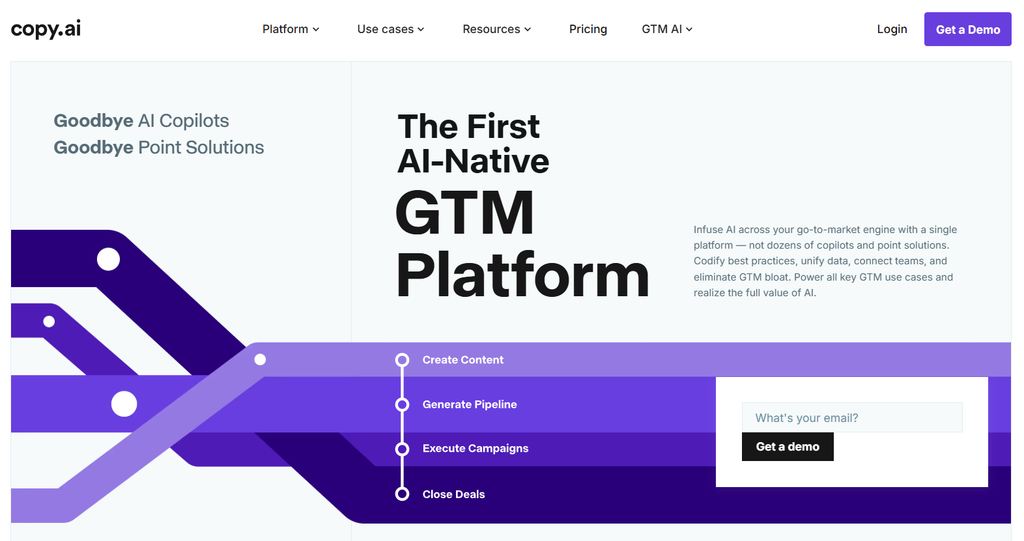
The platform connects to 2,000+ integrations alongside a custom workflow builder that links to CRMs, enrichment tools, and content systems. Users can route tasks across models from OpenAI, Anthropic, and Perplexity within a single workflow.
Content Agent Studio, launched in June 2025, is the most directly comparable feature to AirOps — it trains branded agents from a few content examples to handle content creation workflows. Newer platform components include Tables (a queryable data layer), Infobase (a company knowledge repository), and Brand Voice. But Copy.ai’s primary value is automating the operational work around content, not the writing itself.
- Pricing: The Chat plan at $24/mo (annual, $29 monthly) covers 5 seats with unlimited AI chat — but no workflow automation. Workflows start at the Growth plan: $1,000/mo, scaling to $2,000/mo and $3,000/mo. Enterprise is custom with API access and unlimited workflows.
- Ratings: G2 4.7/5 (21,924+ reviews), Capterra 4.4/5 (65+ reviews). Many reviews date from its earlier AI writing tool era. (Verify current figures before publishing.)
- What to watch for: The pricing gap between the $24/mo chat plan and the $1,000/mo workflow plan is massive. Small teams get AI chat, but the workflow automation that makes Copy.ai a real AirOps alternative requires enterprise-level investment. Workflow credits are consumed variably based on complexity, which creates the same cost unpredictability that pushes teams away from AirOps. Content quality requires human review — G2 reviewers note it’s “hard to get accurate sources” and the output “may lack the human touch.”
- Best for: Mid-market to enterprise teams that need to automate GTM workflows across sales, marketing, and operations — not just SEO content. If your AirOps use case extends beyond content into lead enrichment, outreach, and competitive intelligence, Copy.ai’s broader workflow automation may be a better fit. For SEO-only teams, the purpose-built alternatives higher on this list offer more relevant features at lower price points.
How to choose the right AirOps alternative
Match the tool to your primary content goal
- Optimizing existing content: Surfer SEO or Clearscope
- Creating content briefs and research: Frase or MarketMuse
- Scaling branded content: Jasper AI or Writer
- Tracking AI search visibility: Writesonic or Frase
- Automating GTM workflows: Copy.ai
Find Your Match
Which AirOps Alternative Should You Choose?
Pick your primary goal and get a recommendation. Most teams match a tool to one job rather than buying an all-in-one.
What do you most need the tool to do?
▲ Select a goal above to see the best-fit tools.
Recommended for you
Consider your team size and technical expertise
Clearscope (ease of use 9.6/10) and Frase (7-day free trial, intuitive editor) get teams producing content quickly without extensive setup. MarketMuse and Writer have steeper learning curves that can delay time-to-value by weeks. Copy.ai’s workflow builder sits in between: simpler than AirOps but still requires workflow design skills.
Evaluate total cost of ownership beyond subscription price
A $99/month tool that produces content requiring two hours of editing costs more than a $199/month tool that produces publish-ready drafts. Factor in training time, integration setup, and the editing overhead each tool creates. Watch for hidden costs: Frase’s add-ons can inflate a $49/mo plan to $75/mo, Writesonic locks its full Action Center behind the Enterprise tier, and MarketMuse now requires a sales call to get a price at all.
Test content quality before committing
Run the same brief through multiple tools during their free trials. Frase offers a 7-day trial with no credit card. Jasper and Writer provide 7-day and 14-day trials, respectively. Surfer has no free trial — only a 7-day money-back guarantee. Compare the output side by side. The tool that produces the cleanest first draft saves the most time over hundreds of articles.
When a human writer beats AI content tools
Thought leadership and original research content
AI tools can’t conduct interviews, analyze proprietary data, or share genuine expert perspectives. Content that requires original insights needs a human behind it.
Technical topics requiring subject matter expertise
Complex B2B SaaS topics demand writers who understand the product and audience deeply. AI tools produce surface-level content that misses critical nuance.
Content that builds genuine E-E-A-T and authority
Google’s E-E-A-T guidelines reward real-world experience and expertise. AI-generated content lacks the personal experience and credibility signals that build authority over time. Working with an experienced SaaS content writer ensures your content demonstrates the expertise that both search engines and readers recognize.
Find the right content partner for your SEO goals
The right choice between AI tools and human writers depends on your content goals and quality standards. Teams that want AI assistants to handle the heavy lifting have plenty of options above. But for SEO content that ranks in traditional search, gets cited in AI search, and resonates with readers, working with an experienced writer delivers results AI tools can’t match.
Need content that ranks, shows in AI search, and people want to read? Let’s chat!
FAQs about AirOps alternatives
What is the typical learning curve for switching from AirOps to another platform?
The learning curve depends on the tool you choose. Clearscope, Frase, and Surfer SEO have the shortest ramp-up times — most teams produce content within the first week.
Clearscope has a G2 ease of use rating of 9.6/10 and an ease of setup rating of 9.8/10. Writers can start using it with minimal training, especially through the Google Docs integration. Frase offers a 7-day free trial with no credit card, and agencies report getting teams productive within days.
MarketMuse and Writer sit at the other end. MarketMuse’s interface takes weeks to learn, and Writer’s platform complexity means many users never get past onboarding at enterprise scale.
Can SEO teams use multiple AI content tools together?
SEO teams regularly combine tools for different purposes rather than relying on a single platform. The key is mapping each tool to a specific stage of your content workflow and avoiding redundant features that inflate costs.
Common pairings include Frase for briefs with Surfer SEO for optimization, and using Jasper AI for brand-consistent generation alongside a dedicated optimization tool. Many teams use ChatGPT or Claude for drafting, then run the output through Clearscope or Surfer for SEO alignment.
Clearscope users often pair with Ahrefs or Semrush for keyword research and backlinks, since Clearscope deliberately doesn’t cover those areas.
How do AirOps alternatives handle content refreshes and updates?
Most alternatives on this list include built-in content refresh capabilities tied to Google Search Console data.
Surfer SEO’s Content Audit provides domain-wide performance tracking with weekly recommendations and rank drop alerts. Clearscope’s Content Inventory includes automated alerts for 404s, indexing issues, and content decay — a safety net for teams that manage large content libraries.
Frase’s Content Guard automatically detects ranking and traffic decay, drafts the fix, and republishes on approval. MarketMuse’s content inventory audits existing pages and prioritizes which to update, create, or consolidate based on personalized authority metrics.
Which AirOps alternative integrates best with WordPress?
Surfer SEO and Clearscope offer the strongest WordPress and CMS integrations among the alternatives on this list.
Surfer SEO has a dedicated WordPress plugin and Google Docs integration. Clearscope integrates with Google Docs, WordPress, and Microsoft Word — the Google Docs integration is particularly praised in reviews. Frase provides Google Docs integration plus a REST API and MCP server for Claude/ChatGPT integration.
Jasper AI has a browser extension and integrations including Semrush, Webflow, and WordPress. Writesonic’s AI Traffic Analytics integrates with WordPress, Cloudflare, and Vercel.
Are there free AirOps alternatives worth considering for small teams?
No free tool provides comprehensive SEO content functionality. The most affordable full-featured option is Frase at $39/month with annual billing, which includes the AI Agent, SEO + GEO optimization, and site audits.
MarketMuse offers a free tier, but it’s limited and not viable for real work. Writesonic provides free AI Traffic Analytics on all plans. Surfer SEO starts at $49/month (Discovery, content only) or $99/month for its main Standard plan, with no free trial — only a 7-day money-back guarantee.
Which AirOps alternatives offer AI search visibility tracking (GEO)?
Several alternatives on this list now offer AI search visibility tracking comparable to AirOps’ prompt tracking capabilities.
Writesonic monitors 10 AI platforms with an Action Center that converts gaps into specific fixes, though the full Action Center requires the Enterprise plan. Frase tracks five platforms (ChatGPT, Perplexity, Claude, Gemini, Google AI) on standard plans, scaling to eight at Enterprise. Surfer SEO’s AI Tracker covers ChatGPT, Perplexity, Google AI Mode, Google AI Overviews, and Gemini. Clearscope’s Query Tracking monitors brand visibility across ChatGPT, Gemini, and Claude.
AI Search Visibility
Which AI Engines Each Tool Tracks
Only the four alternatives with built-in AI-visibility tracking are shown. The others on this list don’t monitor AI search engines.
| Tool | ChatGPT | Claude | Perplexity | Gemini | Google AIO | Copilot | Grok | DeepSeek | Meta AI |
|---|---|---|---|---|---|---|---|---|---|
| Surfer SEO | ✓ | – | ✓ | ✓ | ✓ | – | – | – | – |
| Clearscope | ✓ | ✓ | – | ✓ | – | – | – | – | – |
| Frase | ✓ | ✓ | ✓ | ✓ | ✓ | E | E | E | – |
| Writesonic | ✓ | ✓ | ✓ | ✓ | ✓ | ✓ | ✓ | ✓ | ✓ |
Surfer SEO also tracks Google AI Mode. Writesonic tracks 10 platforms in total — the nine named here plus one more. “Google AIO” = Google AI Overviews.
Coverage as of October 2026, from vendor feature pages. AI-tracking platform lists change frequently — verify before purchase.
How do AirOps alternatives compare on pricing?
All alternatives on this list use flat subscription models rather than AirOps’ task-based pricing, which gives teams predictable monthly costs instead of bills that spike with increased workflow runs.
From lowest to highest starting price: Writer ($29/user/mo annual), Frase ($39/mo annual), Surfer SEO ($49/mo Discovery, or $99/mo Standard), Jasper AI ($59/seat/mo annual), Writesonic ($79/mo Starter), and Clearscope ($129/mo). Copy.ai starts at $24/mo for chat, but workflow automation requires $1,000/mo. MarketMuse is now quote-based, requiring a sales conversation for pricing.
